

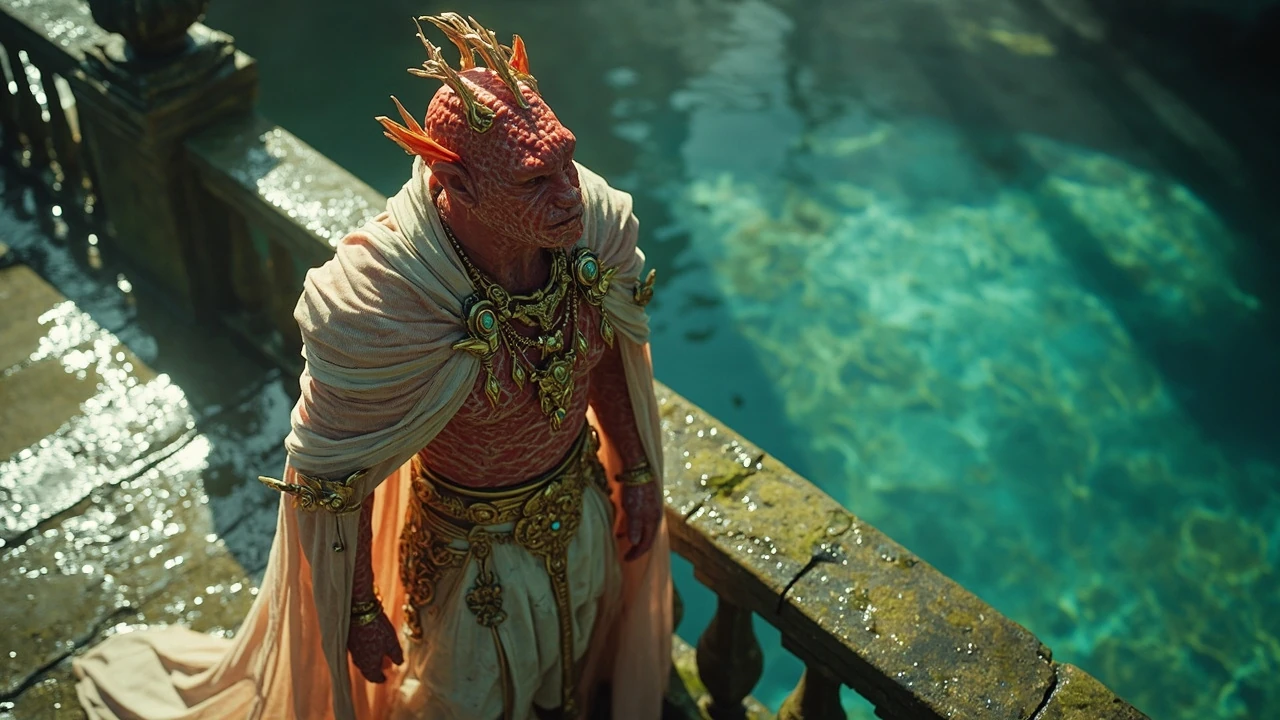
Sidon of the Zora as a GameDev reference point
Sidon of the Zora is the prince of Zora’s Domain in Nintendo’s The Legend of Zelda: Breath of the Wild and The Legend of Zelda: Tears of the Kingdom. For game developers, character designers, and narrative designers, the character is a useful case study because he sits at the intersection of several disciplines at once: silhouette and color theory, animation and water-based traversal, AI behavior and combat scripting, questline pacing, and the way a recurring NPC can absorb player feedback across two open-world entries. This article treats Sidon of the Zora as a design object and a production subject, with attention to what developers can actually learn from his implementation and from the way his storyline is gated in the world quest that bears his name.
Rather than retelling the plot, the goal here is to break down how a single NPC in a major franchise is constructed, animated, voiced, scripted, and integrated into a questline. If you are a technical artist, the swimming and water-spout combat mechanics are relevant. If you are a quest or narrative designer, the way the Sidon of the Zora quest gates story progression while still allowing backtracking and optional preparation is worth studying. If you are a producer or technical lead, the vertical-slice structure of the Ploymus Mountain segment is a small lesson in how a single NPC’s questline can double as a tutorial for a new traversal ability, and how that lesson has to be carried across re-releases without breaking the existing content.
Character identity and franchise context
Sidon is the son of King Dorephan and Mipha, the latter being the Zora Champion slain during the events of Breath of the Wild. He is taller and visibly more mature than most other Zora NPCs, and he serves as the primary face of Zora’s Domain in both BotW and TOTK. From a design perspective, that positioning matters: he is not a generic village elder and not a side character. He is the quest-giver, the emotional anchor for the domain, and a recurring party member in the DLC content and the main TOTK campaign. He also has to remain recognizable when the camera is far away, when the player is underwater, and when the lighting shifts to a rainstorm at Ploymus Mountain.
For a developer, the decision to make Sidon the public face of the Zora carries production consequences. His model must read clearly at long distances for wayfinding and player signaling, support extensive cinematics without dropping frames on Switch-class hardware, carry emotion with limited facial rigging because the Zora have a stylized, elongated head shape that limits realistic expressions, and stay readable in combat with distinct weapon geometry that does not clip against his fins and tail. These constraints shape everything from polygon allocation to the way his combat voice lines are mixed. They also explain why his design leans heavily on body language, water effects, and lighting rather than detailed facial capture, and why his hand poses and shoulder positions carry a large share of the storytelling.
Silhouette, color, and shape language
The Zora are defined by a tight, recurring shape language: long heads, swept-back fins, webbed hands, and tails. Sidon of the Zora differentiates himself within that family with a few deliberate choices that any small studio can study in isolation.
| Design element | How Sidon uses it | Development implication |
|---|---|---|
| Color | Warm reds, coral pinks, and gold accents against the cool blue-gray of the Zora. | Clear read against water and against most other Zora; doubles as a heat-map color cue in combat. |
| Size | Notably taller than other Zora, broader shoulders, more pronounced musculature. | Requires adjusted hit volumes, camera framing, and a higher-resolution silhouette pass to avoid pop-in at distance. |
| Jewelry | Coral and gold ornaments referencing royalty and Mipha’s design. | Helps designers signal lineage; gives lighting and FX teams anchored points for sparkles and weather responses. |
| Armor | More coverage than civilians, less than a heavy combat class; ceremonial feel. | Sits between civilian and combat rigs, useful for designers who need a midpoint template for royal NPCs. |
| Fins and tail | Larger, more expressive swing range than civilians. | Animation teams have to budget extra cloth and fin sim passes during cinematics and rain scenes. |
| Eye and mouth area | Bright teeth, large visible eyes, exaggerated brow line. | Carries emotion in a stylized rig where realistic face capture is not viable. |
The result is a character who is unmistakably a Zora, but whose silhouette reads as leadership rather than a generic villager. That distinction is the kind of decision a small studio can apply to its own factions: a single shape or color change, applied consistently across an NPC group, can carry a large amount of narrative weight without adding new assets, and it survives the kind of camera compression you get in handheld mode on Switch-class hardware.
Animation and locomotion systems
The Zora are amphibious, and Sidon of the Zora has to look correct on land, swimming, leaping out of water, and combat-stomping. That requirement is a useful test for any studio building a multi-state locomotion system, because the four states have to blend without visible pops, and they have to share a single root-motion budget so the player camera does not snap during transitions.
- Swim cycles: the base Zora swim is a smooth full-body undulation, but Sidon uses a slightly faster, more aggressive cycle to mark him as a fighter.
- Out-of-water gait: a deliberate, slightly heavy walk that telegraphs his size without breaking the world art direction.
- Water spout combat: a vertical leap combined with a downward slash, with water FX for impact and screen-shake on contact.
- Emote cycles: hand-on-chest greetings, hopeful stances during cutscenes, and combat-ready poses before boss phases.
- Leap-out: a single rising animation used to enter and exit water, which doubles as a traversal tool for the player during escort segments.
For technical animators, the more interesting work is in transitions. A Zora can move from idle on a ledge to dive, to swim, to leap, all inside a single player prompt. Each transition requires a blend tree with safe angles, a consistent root motion vector, and a script that prevents the player camera from snapping when the character exits water. A studio porting Sidon-like behavior to its own aquatic NPCs should budget blend states and edge-case animations first, and budget hero cinematics second; broken transitions are the first thing playtesters notice in a water-heavy area, and they are also the first thing streamers will put in a thumbnail.
AI behavior and combat scripting
Outside the main story, Sidon of the Zora is an allied NPC in Breath of the Wild’s Divine Beast Vah Ruta sequence and returns as an ally in TOTK. His combat behavior is built around a few repeating patterns that can be reused or adapted by developers working on cooperative AI, and each pattern is a small test for the systems that surround it.
| Pattern | Trigger | What it tests for AI programmers |
|---|---|---|
| Water spout leap | Engaged target within range. | Verticality checks, nav-mesh fallback when the water surface is missing. |
| Melee combo | Close-range, no cooldown on a global ability. | Animation cancellation, hit-volume timing, friendly-fire prevention. |
| Defensive retreat | Health threshold or ally death. | State machine transitions and how designers expose them for tuning. |
| Revive or shield support | Player in danger during a story phase. | Ally cooperation with player invulnerability frames during scripted moments. |
| Taunt and aggro pull | Multiple hostiles close to the player. | Threat table weighting and how a designer can rebalance aggro without rewriting behavior trees. |
| Idle chatter | Player nearby for more than a set time. | Dialogue budget, distance gating, and avoiding line fatigue on long sessions. |
The Sidon of the Zora quest in TOTK uses a similar scripting pattern at a larger scale. The Ploymus Mountain phase is a waygate that doubles as a tutorial: the player must reach a summit, signal the prince, and continue a longer chain. Each of those beats is a script that conditionally spawns enemies, water, and weather, and then hands control back to the player. The system is a good example of a quest graph that branches in obvious places and falls back to a linear path when conditions are not met, which is exactly the kind of structure a small team can keep in version control without it collapsing under its own weight.
Questline design and the Sidon of the Zora quest
In TOTK, the Sidon of the Zora questline is the main story chain for Zora’s Domain. It opens after the player has done the prerequisite that restores the Zora Armor and follows a short optional path up waterfalls, with each step functioning as a soft tutorial. According to the official Sidon of the Zora walkthrough reference, the quest sends the player east from Zora’s Domain and over a chain of waterfalls before climbing Ploymus Mountain. Players who completed the prior Zora Armor step are expected to use the Zora Armor, and a Sticky Elixir is recommended for the climbing segments. The page also notes that the chain is part of a larger set of related main quests that gate the larger TOTK narrative, which is consistent with how Nintendo structures its main quest hubs, and it is also explicit that the guide has been tested on the Tears of the Kingdom Switch 2 Edition released in 2025, which matters for studios thinking about their own re-release planning.
For quest designers, the relevant takeaways are practical rather than abstract:
- Prerequisite gating: a clear required quest and a soft, recommended set of optional preparations. This pattern is reusable in any studio that wants a friendly, non-blocking prerequisite system.
- Environmental tutorial: waterfalls teach the Zora Armor ability without an explicit tutorial UI. This is an example of environmental learning that does not require voice lines or text pop-ups.
- Locational anchoring: the chain is anchored to a single NPC, which simplifies UI waypoints and reduces scripting branches.
- Soft difficulty curve: climbing and water traversal ramp gradually, and the player can detour to a cave to pick up part of the Climber’s Set if their stamina is short.
- Optional preparation: the walkthrough frames certain steps as optional but highly recommended, which is a useful copy pattern for in-game journals that need to nudge without nagging.
- Glide landing: the Ploymus ascent ends with a glide to the mountainside, which is a quiet test of whether the player has internalized the paraglider earlier in the campaign.
None of these techniques are unique to TOTK, but bundling them into a single questline anchored to a charismatic NPC is a clean implementation. Studios with limited quest-writing capacity can lift the structure directly and use their own NPC as the anchor, and they can add a side cave that the walkthrough explicitly mentions (Ploymus Mountain Cave) so that the optional preparation has a concrete location rather than a generic hint.
Narrative role across two games
Sidon of the Zora has a different narrative function in BotW than in TOTK, and that difference is instructive for writers working on sequels, expansions, or content updates. The continuity of the character is the whole point: he has to feel like the same person across two open-world releases, but he also has to feel like he has lived through the events of the first game.
| Title | Narrative role | Player relationship | What it tests for writers |
|---|---|---|---|
| Breath of the Wild | Hopeful ally supporting the Zora Champion’s legacy. | Sympathetic, light, supportive. | Writing an NPC who carries the emotional weight of a deceased relative without becoming a grief monologue. |
| Tears of the Kingdom | Established leader, more self-possessed, more authority. | Equal partner, occasional comic relief. | Showing growth without retconning the original personality; writing a sequel character who is recognizably the same but visibly matured. |
| Champions’ Ballad content | Recurring ally with light callback lines to Mipha. | Sentimental without being heavy. | Calibrating nostalgia so that long-time players feel rewarded without new players feeling locked out. |
Writers working on sequels or updates can study how Sidon’s voice lines shift from encouragement to leadership without abandoning his core tone. The character’s optimism remains intact, but the way he speaks about the domain, the player, and his own people is more assured. That kind of subtle continuity is hard to deliver, and it depends on a writer’s room that has access to the original recording sessions and the original script, plus a localization pass that knows which phrases are load-bearing and which can be re-cut freely.
Voice, localization, and accessibility
Voice acting is a major part of Sidon of the Zora’s presence. In the English version he is voiced with a bright, energetic tone that matches his on-screen animation. The Japanese and other localized versions adjust delivery without losing the underlying intent, which is a good demonstration of how casting and direction can be tuned regionally without rewriting the character. For developers shipping in multiple languages, the lesson is to write characters whose emotional beats are clear enough to be performed in any language, rather than relying on wordplay, idioms, or specific dialects that will not survive translation.
Accessibility considerations also matter. The Zora Armor traversal in the quest is a path of least resistance for players who dislike climbing, and the optional Sticky Elixir route means the quest is still completable for players with low stamina or low precision. Studios building their own traversal-heavy quests can borrow the pattern: provide a default path and a softer alternative, and let the player choose which is more fun. The walkthrough language supports this reading, because it explicitly lists the Sticky Elixir as a recommendation rather than a requirement, which is a small but useful piece of UI copy that signals permission to take the easier path.
Combat tuning and balance for a recurring ally
Because Sidon of the Zora is a recurring combat ally, his tuning directly affects player satisfaction. If he is too weak, players feel like they are carrying him. If he is too strong, the same encounters feel trivial. The balance approach in BotW and TOTK follows a few consistent rules that are easy to lift into other games.
- Damage output is high enough to remove standard enemies but not high enough to delete boss-tier threats.
- Health is tuned so that he can survive two or three standard hits but is genuinely vulnerable to area-of-effect damage.
- He draws enemy attention away from the player at scripted moments, which doubles as a way to let the player reposition.
- He is not essential to win, so the encounter remains accessible to players who prefer to fight alone.
- His revival behavior is conservative, so that an over-eager ally does not steal the player’s clutch moments.
For technical designers and combat engineers, the implementation pattern is: a high-damage, moderate-health ally whose aggro radius is large enough to feel present but small enough to allow the player to control who they are fighting. A simple AI utility score, weighted toward the closest enemy, is usually enough, and the same utility score can be reused for non-ally NPCs in the same encounter by flipping a single flag.
Worldbuilding and faction design
Zora’s Domain is one of several major races in BotW and TOTK, and Sidon is its most visible representative. That visibility means he carries a lot of worldbuilding weight: the Zora architecture, the relationship with water and rain, the memory of the Champions, and the political relationship with Hyrule’s central monarchy. The character’s recurring presence in cinematics, idle dialogue, and in-game notes is a small lesson in how to expose lore without forcing the player into a codex, and the same approach works for studios that want a single NPC to anchor an entire region of their open world.
For studios designing their own faction leaders, the pattern is recognizable: a single recurring NPC anchors the lore, and the rest of the faction is built around them with shared language, music, and visual motifs. The risk is over-reliance on a single character, so design teams should always keep a small bench of secondary NPCs who can carry the same tone if the primary is absent or injured in the story. A useful internal test is to ask whether the faction still feels coherent in screenshots where the leader is not visible, and if the answer is no, the supporting cast needs more art direction.
Production notes for studios
For a small or mid-sized studio, the cost of building a Sidon-tier NPC is significant, and it is worth being honest about the asset list before committing to a similar scope. The asset list typically includes a high-resolution hero model with LODs and color variants for cinematics, a full facial rig with at least one blend-shape set for cinematics and a lighter set for gameplay, a combat anim set of roughly twenty to forty clips plus transitions, a locomotion blend tree with idle, walk, run, swim, and traversal cycles, voice lines in every shipped language with a director’s pass per language, an AI behavior tree or utility AI script with combat, retreat, support, and idle states, a quest script for the main questline plus variants for backtracking and alt-start conditions, and a cinematic script with camera, lighting, and audio cues. On top of that, the team has to budget a porting pass for any new platform release, because the hero NPC is the first asset that breaks a memory budget.
A realistic budget for a hero NPC of this scope is on the order of a senior content team working across multiple disciplines for several months, plus a localization pass. Smaller studios can still benefit from the same asset structure by scaling the asset set: one cinematic-quality head, a few core anims, and a minimal quest script will deliver a similar player experience at a fraction of the cost. The trap to avoid is treating the smaller scope as a reason to skip the discipline of an asset list entirely; even a short list is better than no list, and it is the only way to know whether the NPC is on track before the milestone review.
Ports, remasters, and continuity
Sidon of the Zora has appeared across the Switch original, later marketing beats, cloud versions on some platforms, and the Switch 2 Edition referenced in the walkthrough excerpt. Each new release is a real porting test. Texture compression, draw call budget, and animation streaming are all affected by the hero NPC’s asset weight, and the same applies to memory budgets for his voice line bank. Studios planning their own rereleases should run a budget pass on their hero NPCs first, since they dominate profiling sessions and are usually the first place memory budgets break.
Continuity is also a content problem, not just a graphics problem. If a new platform release updates a mechanic that Sidon relies on, his questline has to be re-tuned to keep the soft-tutorial design working. The same issue applies to balance changes, since combat tuning will invalidate any AI utility scores written for the old numbers. The walkthrough’s note that the guide has been tested on the Switch 2 Edition is a small but useful reminder that even an established quest has to be re-validated, not just re-rendered, when the platform changes.
Player signal and emotional design
One reason Sidon of the Zora works as a character is that he is consistently optimistic and visibly motivated. He greets the player, encourages them during cinematics, and thanks them by name after the main quest. That kind of consistent positive feedback is more powerful than long dialogue, and it is a useful pattern for studios whose writers are short on time. A small bank of contextual voice lines, played at the right beats, can carry a character more than a long monologue. The cost is similar, the localization is smaller, and the player remembers the beats more clearly.
The risk is overuse. If an NPC thanks the player after every encounter, the thanks lose meaning. The convention in the Zelda series is to concentrate emotional feedback at key story beats and keep ambient dialogue short, with a small bank of friendly lines for the long stretches in between. That pacing is a good default for studios building their own hero NPCs, and it is also a useful rule of thumb when the audio budget is tight: spend the lines on moments the player will quote, not on filler that the player will mute.
Frequently asked questions
Who is Sidon of the Zora in the Zelda series?
Sidon of the Zora is the prince of Zora’s Domain in The Legend of Zelda: Breath of the Wild and The Legend of Zelda: Tears of the Kingdom. He is the son of King Dorephan and Mipha, the Champion whose spirit still watches over the domain. He functions as the primary quest-giver for the Zora and as a recurring allied NPC in combat.
What is the Sidon of the Zora quest in TOTK?
It is the main story questline for Zora’s Domain in Tears of the Kingdom. The chain begins once the Zora Armor is restored, and the early phase sends the player east from the domain to climb waterfalls and ascend Ploymus Mountain, with a glide to the eastern mountainside as the safe landing. The same reference is the practical source for the prerequisites and the optional preparation steps.
What does the player need before starting the quest?
The Zora Armor, which is recovered during a prerequisite quest that restores it. Climbing items such as a Sticky Elixir are recommended but not strictly required, and stamina management is the practical gating factor. Optional preparations include stocking meals and exploring nearby caves for stamina upgrades, and a side detour to Ploymus Mountain Cave is available for a piece of the Climber’s Set.
How does Sidon’s combat behavior work?
Sidon uses a vertical water-spout leap, melee combos, and a defensive retreat when his health is low. He draws enemy attention away from the player at scripted moments, which gives the player room to reposition. His tuning is balanced so that he is helpful but not essential to winning encounters.
What design lessons can small studios learn from Sidon?
The main lessons are silhouette discipline, consistent emotional signaling, and a tightly scoped asset list. A small studio can deliver a Sidon-like NPC with one cinematic head, a handful of core anims, a basic AI behavior tree, and a short voice line bank. The most important choice is the character’s emotional tone, which has to be consistent across cinematics, combat, and idle states.
Is Sidon playable in either game?
He is not a player character in the main campaign, but he is a controllable ally in DLC content and in scripted combat encounters in TOTK. For developers, the design question is similar to other party-ally systems: how much control does the player have, and how much of the NPC’s behavior is autonomous?
How does Sidon differ between BotW and TOTK?
His role shifts from a hopeful young ally carrying the weight of Mipha’s memory to a more authoritative leader. His combat tuning is broadly similar, but his dialogue is more self-possessed in TOTK. The visual design is mostly unchanged, which is a deliberate choice to preserve recognition across the two games.
What makes Sidon’s questline a good environmental tutorial?
The chain teaches the Zora Armor’s swimming ability through waterfalls and the paraglider through the Ploymus Mountain glide, without explicit pop-ups. The cave detour teaches the value of optional preparation, and the recommended Sticky Elixir teaches the player that the quest is tuned for stamina as a resource rather than a stat wall.
How does the quest hold up on the Switch 2 Edition?
The reference notes that the walkthrough has been tested on the Tears of the Kingdom Switch 2 Edition released in 2025, and the quest structure still works on the newer hardware. For developers, the practical takeaway is that a quest with strong environmental teaching ages better across hardware revisions than one that depends on button prompts or UI overlays.
Why is Sidon such a memorable supporting character?
A distinctive silhouette, a consistent optimistic voice performance, and a questline that lets the player spend time with him in different contexts. Each of those factors reinforces the others, which is why the character keeps showing up in franchise retrospectives and why the visual design has stayed largely stable across two open-world releases.


Leave a Reply