

A lay of the land in Arc Raiders: how a tutorial mission is designed to teach extraction
A lay of the land is the first main mission in Embark Studios’ Arc Raiders, and the studio has loaded it with almost every system the rest of the game depends on. A new player has to absorb scanning, threat reading, movement, scavenging, and the rules of leaving a map alive, usually before deciding whether the game deserves another evening. The mission is short on purpose. It runs the player through the core loop in the same order they will repeat it later, and it does so without leaning on pop-ups or scripted lectures. For developers, it is also one of the cleaner public examples of onboarding in a high-stakes genre.
This piece reads a lay of the land arc raiders as both a player-facing mission and a design case study. It walks through how the mission structures scanning, combat, scavenging, and extraction, then turns to what other studios can borrow, what depends on Arc Raiders’ specific design, and where the mission still has rough edges. The aim is to read one tutorial mission the way a production team would: as a small but representative piece of work that shows how a studio teaches its loop.
What the mission actually covers
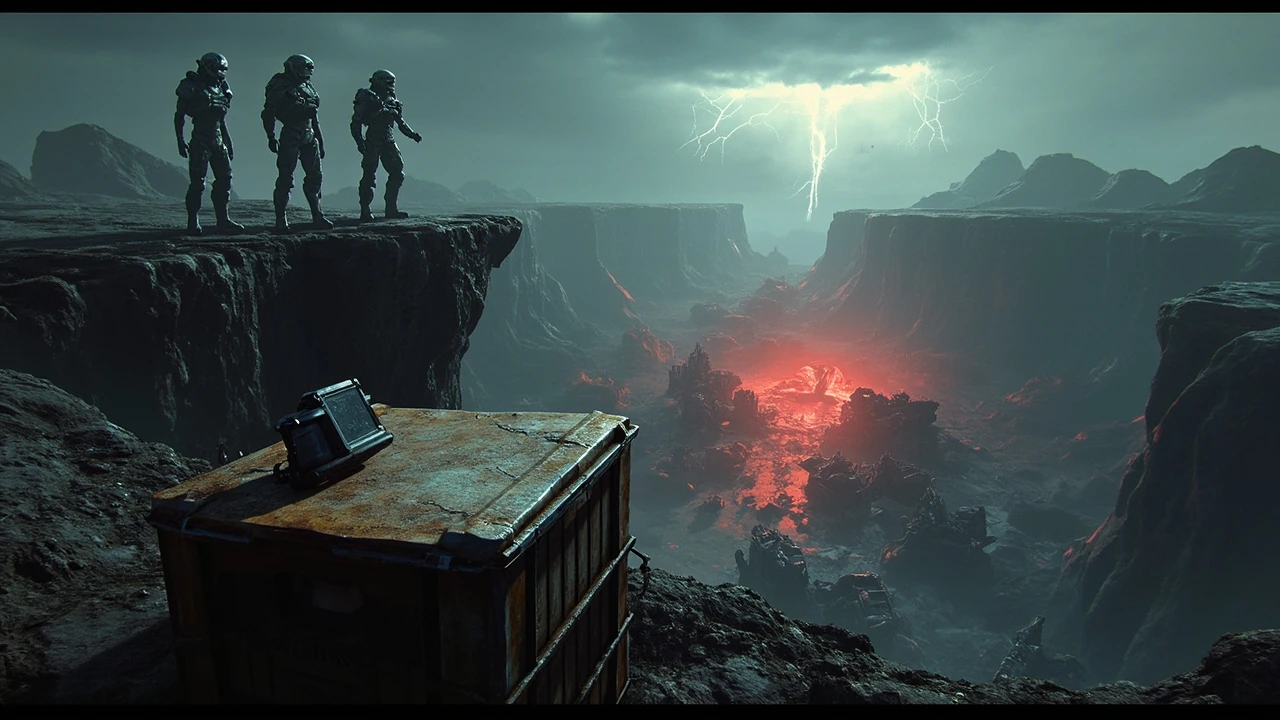
The English idiom “lay of the land” means surveying a place before committing to action, and Embark leans on that meaning almost literally. The player starts on a high ridge, scans the area below, picks a path down, fights a small ARC group, scavenges a few resources, and ends at an extraction shuttle. The mission is short, and it touches nearly every system the rest of the game depends on.
Rather than front-loading tooltips, the mission asks the player to perform the actions the game is built around, in the same order those actions occur in normal play. The pacing is closer to a guided exercise than a scripted tutorial. Below is the practical structure most players walk through, based on how the mission unfolds on the public test build of Arc Raiders and on Embark’s public comments about onboarding.
- Vantage scan. The player starts on elevated terrain and is prompted to use the scanner to mark machines, resources, and a sample of threats. Reading a battlefield before descending is introduced as a habit rather than a one-time instruction.
- Approach route. The player picks a path down toward a designated zone, choosing between a quieter route and a more direct one. Both are valid, and the choice is the first small expression of risk preference.
- First contact. A controlled combat encounter with a small ARC group introduces firing, cover use, and the visual language of stagger and weak points.
- Resource pass. A short scavenging segment establishes the relationship between items, weight, and what the player can carry to extraction.
- Extraction decision. The player reaches the extraction point, calls the shuttle, and defends a small area for a short window. The win condition is leaving, not killing everything.
Each of those steps maps to a system that recurs across the rest of the game. The mission is not a sandbox that is discarded after the credits roll. It is a compressed version of the normal session loop, with the difficulty curve turned low enough that a new player can finish it without prior knowledge of the genre.
Why the mission is a useful onboarding case study
Extraction shooters are hard to teach. The genre punishes the unprepared with inventory loss, permadeath pressure, or a long walk back to a fight. Players who lose everything in their first ten minutes rarely return. That tension is the reason a clean tutorial mission matters, and it is the reason a lay of the land arc raiders is treated as a small but carefully built piece of work.
Three design choices make the mission worth studying. First, it frames scanning as an exploratory gesture instead of a chore, by tying the scanner to a moment of relative safety on a ridge. Second, it sequences scanning, movement, combat, scavenging, and extraction in the same order the player will repeat in regular play, so the lesson and the practice are identical. Third, it ends on extraction rather than on a kill count, reinforcing that the loop’s goal is leaving, not eliminating.
For developers outside the genre, the lesson is structural rather than mechanical. The mission is a pattern for introducing any loop with a high cost of failure: build a small, low-stakes environment where the player can rehearse the loop in order, with a forgiving safety net underneath.
How the scanner is taught without a manual
Scanning in Arc Raiders is the player’s primary way of reading the world. It marks enemies, points of interest, and loot, and it informs whether an approach is worth the risk. In a hands-off tutorial, scanning is usually explained with a UI popup. In a lay of the land, the player is placed on a ridge that makes scanning feel like a natural response to a real question: what is down there?
The mission uses spatial staging rather than a tooltip. The player is high up, the threats are visible, and the scanner is the only tool that resolves the unknown into markers and distances. The control prompt is short, and the next line of guidance is the player’s own observation. Several design talks about extraction shooters have described this approach as “environmental teaching,” where the level geometry implies the action.
The risk is that scanning becomes a button the player mashes without understanding what it returns. Embark addresses that by having the scanner highlight a small set of distinct icons during the mission, each tied to a follow-up action: a machine icon that points to the upcoming combat, a loot icon that points to the scavenging pass, and an extraction icon that points to the shuttle. The player learns the icons by using them in context, not by reading a glossary.
Combat introduction: a small, controlled ARC encounter
The first combat encounter in the mission is small on purpose. A short group of low-tier ARC machines, in terrain that allows cover and a clear retreat path. The fight is short, the enemies are predictable, and the player is given enough ammunition and healing that losing is unlikely.
From a development standpoint, this is a deliberate calibration choice. The encounter has to be informative, not punishing. It introduces three ideas at once: ARC units are hostile, the player has the tools to defeat them, and a fight that goes wrong can be reset by retreating to cover rather than by respawning. None of those points is delivered through text. The encounter is the explanation.
The encounter also seeds an expectation that combat in Arc Raiders is staged, not chaotic. ARC machines are not always present, and a careful player can move around them. The mission plants that expectation so that later sessions feel like a series of decisions about when to fight, rather than a continuous firefight.
Scavenging, weight, and the cost of carrying too much
The scavenging pass in the mission is short, but it introduces a system that becomes a real constraint later: weight. The player can pick up more than they can comfortably carry, and the mission hints at that by leaving a few extra resources near the extraction route. Most players will pick them up and feel the difference in movement, then drop the excess before calling the shuttle.
This is one of the more interesting design choices in the mission. The lesson is not “carry everything.” It is “carrying more than you need slows you down, and slow players lose fights.” The player learns that lesson by feeling the movement change, not by reading a tooltip about encumbrance. That kind of feedback is one of the most efficient ways to teach a resource mechanic, because the cost is the game’s normal response, not a dedicated prompt.
For developers, the lesson is that resource systems are easier to teach when the cost of overuse is visible during play. A number, a speed penalty, or a visible strain animation is more durable than a written rule.
Extraction as the win condition
The mission ends on extraction, and the framing of extraction as the goal is the most important conceptual decision in the mission. Arc For additional context, Raiders is built around leaving the map alive, and the tutorial mission establishes that rule by ending on a shuttle ride, not on a kill tally.
The extraction itself is also worth studying. The player calls the shuttle, then defends a small area for a short window. Defending a fixed point is a different task from pushing across a map, and the mission lets the player feel that difference. The shuttle animation, the visible timer, and the moment when the hatch opens are all part of the lesson. The player has survived, and the game tells them so by removing them from the map.
For onboarding design, this is a useful pattern. The end of the tutorial is a calm moment of resolution. That calm matters because it gives the player a memory of the win condition before the next mission raises the stakes.
Comparing the tutorial mission to a standard session
| Element | Tutorial mission (A lay of the land) | Standard session |
|---|---|---|
| Duration | About 10 to 15 minutes for a new player | Open-ended, often 20 to 40 minutes |
| Threat density | One scripted encounter, low enemy count | Multiple encounter types, higher density |
| Scavenging | A small, controlled resource pass | Open scavenging across varied terrain |
| Extraction | A fixed point with a short defend | Multiple options, with a longer defend |
| Failure cost | Low: respawn into the same mission | High: lost gear, long recovery |
| Stakes | Learning the loop | Running the loop under real risk |
The table describes the relationship Embark sets up between the tutorial and the rest of the game. The tutorial is the loop in miniature, with the penalties reduced and the path guided. The standard session is the same loop, larger, and less forgiving.
How the mission fits Embark’s broader onboarding philosophy
Embark has talked publicly, in developer diaries and in press coverage of its earlier projects, about onboarding as a feeling rather than a checklist. The studio has said that the goal of early missions is to make a new player feel that the game respects their time and their decisions. A lay of the land is a clear expression of that philosophy. The mission is short, the choices are real, and the player ends the mission with a small, concrete win.
The mission also reflects a choice the studio has made about information density. Arc Raiders is a game with many overlapping systems: scanning, weight, weapon archetypes, ARC behavior, weather, and the magnetic storm. The tutorial cannot explain all of them, so it explains the smallest set that allows the rest to be discovered. Scanning, fighting, scavenging, and extraction are the four legs. Everything else is layered on top.
For a production team thinking about onboarding, this is the most portable idea. Pick the smallest set of mechanics that lets the player perform the core loop, teach those mechanics in the order the loop uses them, and leave the rest to the player’s curiosity. The expression behind the title itself has a long history, and the entry on The Lay of the Land traces how the idiom has been used in English-language writing over time, which is useful context for a mission title that borrows it directly.
What other extraction games have done differently
A lay of the land is not the only approach to onboarding in the genre, and looking at adjacent games helps identify what is specific to Embark’s choice. The table below compares how a few well-known extraction titles handle their earliest sessions. The categories are simplified to make the structural differences visible, and they describe design patterns rather than player experience guarantees.
| Title | First session goal | How the loop is introduced | Failure cost during onboarding |
|---|---|---|---|
| Arc Raiders | Survey, fight, scavenge, extract | One short mission that mirrors a full session | Respawn into the same mission |
| Escape from Tarkov | Learn the interface and a single map | Multiple short quests across a starter map | Variable, often the full session is at risk |
| The Cycle: Frontier | Survive a short raid | Guided early quests with explicit objectives | Moderate, with starter loadouts |
| Hunt: Showdown | Hunt a target, then extract | Starter hunter, low-tier lobbies | Hunter loss on death, gear loss on extraction failure |
What changes between these patterns is not whether the loop is taught, but how much of the loop is taught at once. Tarkov spreads the early teaching across several short quests. Hunt uses a softer matchmaking pool. The Cycle leans on explicit objective markers. Arc Raiders compresses the loop into one mission and trusts the order of actions to do most of the work.
None of these approaches is universally better. The right choice depends on the difficulty of the loop, the cost of failure, and how much the studio wants to support experimentation. Arc Raiders’ compressed approach works because the mission is forgiving and because the player is given a real choice in how to approach the encounter.
Player choices inside the mission and what they teach
Even in a short tutorial, players can take different paths. The mission’s two most meaningful choices are the approach route down the ridge and whether to pick up extra resources before extraction. Both are small, and both are intended to set a habit.
The approach route teaches that Arc Raiders rewards reading the terrain. The quieter path avoids a few threats, but the more direct path saves time and may make extraction easier. The trade-off is small in the mission, but the same trade-off appears in every later session, where the choice of route often determines whether a player reaches extraction in time.
The scavenging choice teaches that the game’s economy is local. Resources are useful, but carrying too many makes the player slow, and a slow player is more likely to be caught in a bad fight. The mission shows this without words, and the player carries the lesson forward.
- Quiet approach. Slower, fewer encounters, lower resource risk.
- Direct approach. Faster, more contact, more chances to spend ammunition.
- Light carry. Easier movement, faster extraction, fewer resources banked.
- Heavy carry. Slower movement, more tension in combat, more resources banked.
These four micro-decisions are the smallest unit of the game’s risk and reward model, and the mission is where a new player first meets them. For developers, this is the cleanest signal that the tutorial is doing its job: it is teaching the actual decision the game will keep asking the player to make.
Common player mistakes and what they reveal about onboarding
Tutorial missions expose where teaching is incomplete. The mistakes players make in a lay of the land are useful feedback for any team working on onboarding in a high-stakes game.
- Skipping the scanner. Some players rush down the ridge and miss the scanner entirely. They then enter the encounter without a read of the threats. The fix in the mission is forgiving, but the same habit in a later session is costly.
- Overcommitting to combat. A few players treat the encounter as the goal and chase the last machine across the map. The mission ends on extraction, so the chase is wasted time. The lesson is that the score is in leaving, not in kills.
- Ignoring weight. Players who pick up everything often reach extraction slow and miss the defend window. The cost of carrying too much is shown by the movement change, not by a warning.
- Defending the shuttle too aggressively. A small number of players leave the extraction zone to pursue threats. The shuttle timer keeps running, and the player is exposed if the timer runs out in the wrong place.
Each of these mistakes is a teaching opportunity. The mission already covers the first three by being short and forgiving. The fourth is the kind of edge case that a tutorial cannot fully teach, and the design choice is to let the player discover it rather than overload the mission with rules.
Where the tutorial is silent, on purpose
Not everything in Arc Raiders is explained in a lay of the land. Several systems are intentionally left for later missions, and the absence of those systems is part of the mission’s design.
- Multiplayer cooperation. The mission is solo, so the social layer of the game is not introduced. Embark’s choice is to let the first cooperative play happen naturally, in the next session, rather than force it into the tutorial.
- Crafting and progression. The mission does not explain crafting benches, skill tracks, or the meta-progression layer. Those systems are added when the player has a reason to care about them.
- Weather and the magnetic storm. The mission is set in fair conditions, so the storm is not introduced. The storm is a system that needs more player attention than a tutorial can give, and it is reserved for the next set of missions.
- Higher-tier ARC units. The mission uses only the smallest ARC variants. Larger units appear once the player has the tools and the map knowledge to handle them.
This selective silence is a deliberate pattern. The mission teaches the smallest set of mechanics that allows the rest of the game to make sense, and it leaves the rest for later. For developers, this is a useful rule of thumb for any onboarding that has to fit a complex game: a tutorial that tries to explain everything often ends up teaching nothing well.
What game developers can borrow from the mission
For a team designing an onboarding sequence in a high-stakes game, the mission offers a small, reusable pattern. The pattern is not about Arc Raiders specifically, but about the structural choices the mission makes.
- Compress the loop. A tutorial mission should be a compressed version of the full loop, in the same order as the full loop. The player should not have to relearn the order later.
- Stage the teaching in the level. Place the player on terrain that implies the action. A ridge implies scanning. A narrow pass implies a choice of route. A clearing implies a fight.
- End on the loop’s win condition. The mission should end on the same condition the player will pursue later. Ending on a kill count when the loop is about extraction teaches the wrong rule.
- Use the game’s normal feedback. Weight, movement, and timer pressure are more durable than tooltips because they are part of the normal game.
- Leave the deeper systems for later. A tutorial that tries to teach every system often fails to teach any. Pick the smallest set of mechanics that allows the rest to be discovered.
These are not Arc Raiders-specific rules, and they are not a guarantee. They are patterns that the mission uses well, and that other studios have used in different contexts. The value of the mission is that it is a small, public example of onboarding work that can be examined in detail. The title’s idiomatic roots also matter for any studio weighing whether to lean on a familiar phrase, and a published review of the title’s idiomatic roots gives a useful read on how readers tend to interpret the expression when it shows up in a finished work.
What to adapt carefully
Not every choice in the mission is portable. Several depend on Arc Raiders’ specific design, and a team borrowing from the mission should know which choices are context-bound.
The reliance on a vantage point works because Arc Raiders has a strong vertical layer. In a flatter game, the same teaching would need a different staging idea. The scanner-as-first-action works because the scanner is the most central tool in the game. In a game where scanning is a side feature, leading with it would teach the wrong priority. The extraction-first framing works because Arc Raiders is built around leaving the map. In a game where the loop is conquest or completion, ending the tutorial on extraction would be misleading.
The honest answer is that the mission’s pattern is portable, but its specific staging choices are not. A team that copies the structure without adapting the staging will end up with a tutorial that feels out of place in a different game.
How the mission connects to player retention
Onboarding is usually judged by a small set of metrics: completion rate, time to first extraction, and the rate at which new players return for a second session. A lay of the land is designed to perform well on those metrics, and the design choices that make the mission teachable are the same choices that make it retentive.
Completion rate is high because the mission is forgiving. A player who makes a mistake can recover inside the same mission, and the cost of failure is reset rather than carried forward. Time to first extraction is short because the mission is small, and the extraction moment arrives before the player is tired. The return rate is supported because the mission ends on a calm, satisfying moment rather than a frustrating one.
None of those outcomes is guaranteed by the design alone. They depend on a tutorial mission that is well built, well tested, and well integrated with the rest of the game. The mission in Arc Raiders is an example of how the work is done, not a promise that the same work will succeed in every project.
A simple diagnostic for an onboarding mission
| Question | What to look for | Why it matters |
|---|---|---|
| Does the mission end on the loop’s real goal? | The win condition matches the loop’s normal win | Teaches the right priority from the first session |
| Is the teaching staged in the level? | Terrain and lighting imply the action | Reduces dependence on tooltips |
| Is the failure cost forgiving? | Failure is recoverable inside the mission | Keeps the player inside the loop long enough to learn it |
| Is the order of actions the same as in normal play? | Scan, move, fight, scavenge, extract in that order | Removes the cost of relearning the loop later |
| Are the deep systems deferred? | Only the core loop is introduced | Prevents cognitive overload in the first session |
That diagnostic is a starting point, not a checklist. A real onboarding review has to look at playtest footage, completion data, and the player’s own account of the first session. The table is a way to structure that review, not a substitute for it.
Production notes: how a tutorial like this is built
From a production standpoint, the mission is the kind of work that looks simple in the shipped game and takes a long time to build. The work behind a clean onboarding mission is spread across several disciplines, and the cost is mostly in iteration rather than in raw content.
- Level design. The mission’s terrain has to be small, readable, and supportive of the actions the mission teaches. The ridge, the approach path, and the extraction point are all built to imply a choice rather than block it.
- Encounter design. The first ARC encounter has to be informative without being punishing. Tuning that balance is one of the slower parts of the work, and it usually requires several rounds of playtest.
- UI and prompts. The mission uses very few prompts, and each one has to land at the right moment. That is a separate piece of design work, and it is where the most iteration usually happens.
- Audio and feedback. The scanner, the encounter, and the extraction all rely on audio cues to confirm the player’s actions. The audio mix is part of the teaching, and it is tuned alongside the rest of the mission.
- QA and playtest. The mission is played by new players who have no prior knowledge of the game. Watching those sessions is the main way the team learns where the teaching is unclear and where the failure cost is too high or too low.
None of those disciplines is unique to a tutorial mission, but the balance between them is. The mission has to teach, but it also has to feel like the game. That is a tighter brief than a regular mission, and it is the reason tutorial missions take longer than their content size suggests.
Where Embark could still iterate on the mission
Even a well-built tutorial has rough edges, and a lay of the land has a few that are visible to careful players. Talking about them honestly is part of treating the mission as a design case study.
The scanner is introduced with a short prompt, and some players still miss it. A small number of players skip the scanner entirely, and the first combat encounter becomes harder than intended. A possible fix is a stronger environmental cue at the ridge, but the fix has to be balanced against the studio’s preference for a low-prompt teaching style. Another rough edge is the weight system. The movement change is subtle, and players who are new to the genre may not notice it. A clearer signal, without turning the lesson into a tooltip, is a possible follow-up. The extraction defend is the third area where a new player can lose the mission. A few players leave the extraction zone to pursue threats, and the defend window is short. The mission is forgiving, but a clearer visual marker around the defend area would help.
These are not flaws in the sense of mistakes. They are the rough edges that a tutorial always has, and the way a studio iterates on them is part of the work. The interesting question is not whether the mission is perfect, but whether the studio is still watching the data and still adjusting the balance.
How the mission reads in player guides
For players writing or reading a guide to the mission, the work is short enough that a guide is more about preparation than strategy. The most useful things a player can do before the mission are basic: check that the scanner control is mapped, learn the scanner icon set, and pick a loadout that is forgiving. The mission itself rewards calm play, and a guide that suggests rushing is giving the wrong advice.
A practical guide also has to be honest about the mission’s limits. The mission is a tutorial, and it does not introduce the harder ARC units, the storm, or the cooperative layer. A player who treats the mission as a complete picture of the game will be surprised by the first real session. The honest framing is that the mission is the first step, and the rest of the game raises the stakes.
Quick pre-mission checklist
- Confirm the scanner control. Make sure the scanner input is mapped to a comfortable key or button before the mission starts.
- Pick a forgiving loadout. A mid-range weapon and a small healing item are enough. The mission does not require a specialized build.
- Plan to read the ridge. Spend a few seconds on the vantage point. The scanner is the first useful action, and the rest of the mission flows from it.
- Stay near the extraction zone. The defend window is short, and leaving the zone is the most common way to lose the mission.
- Do not chase the last machine. The mission ends on extraction, and a kill in the wrong place costs time.
Why the mission is a good reference for onboarding talks and postmortems
Developers often want a clean, public example of a tutorial mission that can be used in talks, in postmortems, and in onboarding design reviews. A lay of the land in Arc Raiders is a good reference for that work because the mission is small, the design choices are visible, and the studio has talked about the work in public.
For a talk, the mission can be used to illustrate the idea of a compressed loop. For a postmortem, the mission can be used to show how a small level, a small encounter, and a small set of prompts combine into a teaching moment. For an onboarding design review, the mission is a useful benchmark because the choices are explicit and the data is public.
That is the broader value of treating a tutorial mission as a design case study. The mission is small, but it carries a clear set of design ideas, and those ideas can be used in other projects, in other genres, and in other parts of a game. The work of a good onboarding mission is reusable, and that reusability is what makes the mission worth studying.
Closing notes for developers and players
A lay of the land in Arc Raiders is a short mission, and the player who finishes it in fifteen minutes is unlikely to think of it as a design case study. For a developer, the mission is worth the second look. The pattern of compressing the loop, staging the teaching in the level, ending on the loop’s real goal, and leaving the deep systems for later is a portable way to think about onboarding in any high-stakes game.
For a player, the mission is a small but well-built introduction to a game that takes its time before raising the stakes. The mission is the first step, and the rest of the game is the loop the mission is preparing the player to run.
Frequently asked questions
What is “A lay of the land” in Arc Raiders?
It is the first main mission in Arc Raiders, designed to introduce the game’s core loop of scanning, approaching, fighting, scavenging, and extracting. The mission is short and forgiving, and it teaches the order of actions the player will repeat in normal play.
Is the mission the same for every player?
The mission follows a shared structure, but small choices, such as the approach route and the amount of resources picked up, are made by the player. The mission is designed so that both a quiet path and a direct path are valid, and the lesson is in the choice rather than in a single correct answer.
Does the mission prepare the player for the hardest content in the game?
The mission prepares the player for the loop, not for the hardest encounters. Higher-tier ARC units, the magnetic storm, and the cooperative layer are introduced in later missions, where the player has more tools and more context to handle them.
Can the mission be failed?
The mission is forgiving, and a failed attempt usually respawns the player back into the same mission with the same loadout. The cost of failure is low by design, so the player can learn the loop without losing gear or progress.
How long does the mission take?
For a new player, the mission usually takes around ten to fifteen minutes, depending on how much time is spent scanning and exploring. Experienced players can finish the mission faster, but the mission is paced for a first-time run.
Does the mission introduce multiplayer?
No. The mission is played solo, and the cooperative layer of Arc Raiders is introduced in later sessions. The studio’s choice is to let the first cooperative play happen naturally rather than force it into the tutorial.
What does the mission teach about the scanner?
It teaches the scanner as the first useful action in any session, by placing the player on a vantage point where scanning is the natural response to a visible question. The mission does not explain the full icon set, and the rest is learned in later play.
Is the mission a good example of onboarding design?
It is a useful case study because the design choices are visible and the mission is short enough to examine in detail. Several studios have used similar patterns, and the mission in Arc Raiders is a clean public example of the approach.
Does the mission change with patches?
Embark has adjusted the mission during the public testing phases of Arc Raiders, including small changes to the scanner prompts, the encounter balance, and the extraction defend window. The structure of the mission has been stable, but the details have been tuned over time.
What should a player take from the mission into the rest of the game?
The most useful takeaway is the order of actions: scan first, then move, then fight when needed, then scavenge, then extract. The rest of the game is the same loop with higher stakes, and the mission is the rehearsal for that loop.




Leave a Reply