

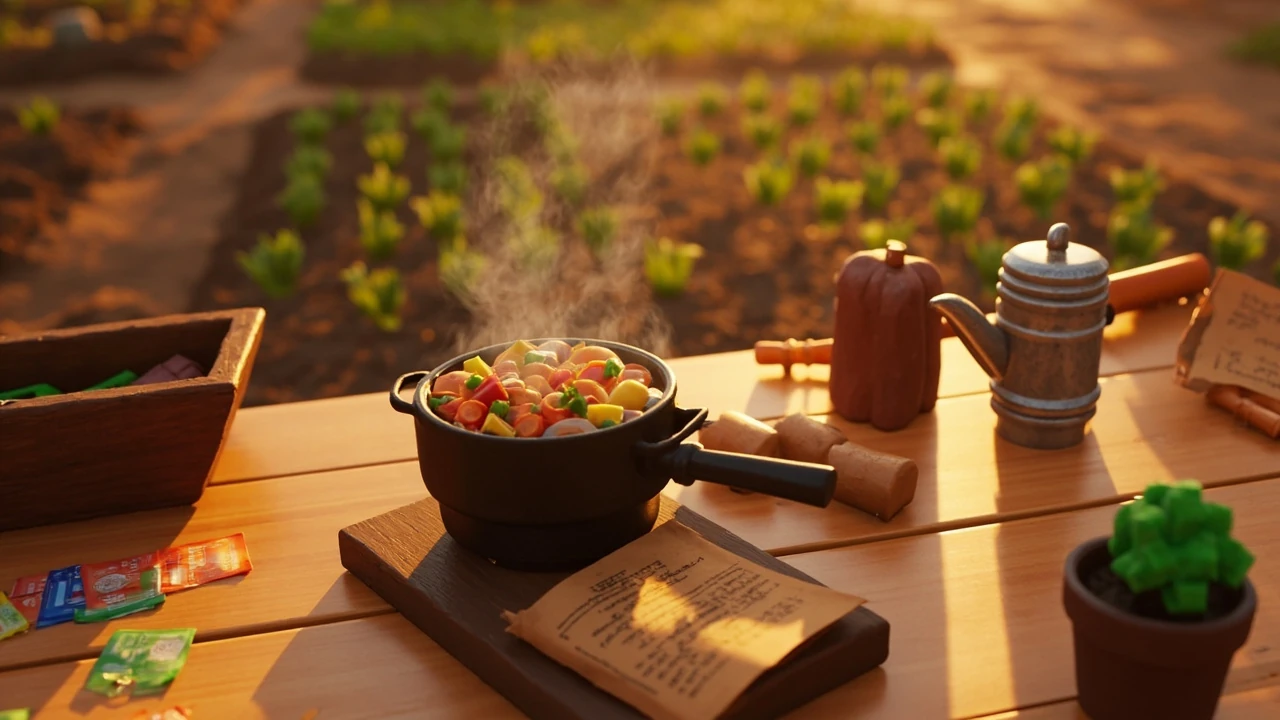
Cooking recipe grow a garden: where the cooking loop meets crop progression
A working cooking recipe in Grow a Garden is more than a flavor item. The cooking station is one of the three pillar systems that sit on top of the base farming loop, and the recipes that come out of it feed back into crop mutations, pet abilities, and the long-tail economy that keeps the Roblox game inside the platform’s top concurrent charts. For developers and designers building their own Roblox titles, or for anyone dissecting live-service progression design, the way cooking is wired into the rest of the game is a useful case study of how a low-stakes secondary loop can carry real weight.
This article breaks down the cooking recipe system inside Grow a Garden: how recipes are discovered, what ingredients actually mean, how the cooking pot interacts with the mutation and pet layers, and the design trade-offs the developers made to keep the loop readable for a young audience. The focus stays on the mechanics a designer can study, with enough context that a player who wants to use a recipe effectively can also follow along.
What “cooking recipe grow a garden” actually means in-game
Inside the game, “cooking recipe” is a specific object class. Players collect, trade, and unlock recipes at the cooking station, then place them in a queue alongside harvested crops, fish, and a few crafted items. The pot returns a finished dish with a rarity tag and a stat profile that interacts with the rest of the world.
The phrase is also the natural way Roblox players search for help, because the in-game cooking UI does not label each recipe by name. A dish is often described by its dominant ingredient plus the word “recipe,” so searches like “soup recipe grow a garden” or “pie recipe grow a garden” are how the community indexes the system. A designer reading the search logs should treat the recipe list as a discoverability surface as much as a progression surface.
The core farming loop before cooking enters the picture
Grow a Garden opens with a small plot, a watering can, and a handful of starter seeds. The first loop the player learns is plant a seed, water it, wait, harvest. The crop comes back with a weight and a base sell value. That is the entire floor of the game, and every other system sits on top of it.
Where the design gets interesting is in the modifiers the game can attach to a crop at the moment it finishes growing. Crops can be picked up with size, color, and mutation tags, and those tags change both the sell price and what the cooking station will accept. A normal carrot is worth a small amount of coins. A carrot with a “wet” mutation, picked during rain, can be worth several times more and can unlock cooking branches that would otherwise be closed.
How the cooking station sits in the world
The cooking station is a single shared structure on each player’s plot. It is not instanced, it does not cost a placement slot, and it persists across server sessions. Players approach the pot, open a radial menu, and choose either a saved recipe or a custom combination of ingredients. Cooking takes real-world seconds, and the pot has a small queue so multiple recipes can run back to back.
The interesting part of the station design is the way the recipe list is presented. Recipes are not unlocked by leveling the player. They are unlocked by placing the right combination of ingredients into the pot and pressing cook. If the combination is recognized, the dish is created and a recipe card is added to the player’s permanent recipe book. If the combination is not recognized, the ingredients are still consumed. That choice is deliberate, and it explains the high search volume for the phrase: the game teaches the loop by failing it.
Recipe discovery and the cost of guessing
Recipe discovery is one of the most discussed design choices in the game’s community. There is no in-game recipe hint system beyond a small set of example dishes. Players learn by either watching streamers, reading community wikis, or by spending ingredients on test cooks. Because failed cooks still consume the items, a player who experiments heavily can burn through an evening’s harvest.
From a production standpoint, the cost of failure is the price of pacing. The developers did not want a single player to hit the entire recipe book in a single session, so they gated discovery behind a real resource cost. That is a useful pattern for any designer who wants a progression curve in a low-stakes Roblox title without locking recipes behind a hard level gate.
What the cooking recipe does to the rest of the loop
Once a recipe is known, the player can cook it on demand. The finished dish has three effects that feed the rest of the system:
- A direct coin value, usually higher than selling the raw ingredients separately.
- A “flavor” tag that matches one of the mutation families, which the game uses to satisfy certain pet hunger states.
- A short-duration buff that increases the chance of a particular mutation on the next crop harvested.
That third effect is the one most players miss, and it is the one that turns cooking from a side activity into a progression tool. A player who times a “soup” dish before watering a high-value seed patch can stack the mutation chance and pull a much better harvest out of the same plot. The recipe is not just output, it is a multiplier on the farming loop the player has already learned.
Ingredient categories and what they signal to the design system
Every ingredient in the game has a rarity tier and a category. The cooking system reads both, and the recipe that comes out is a function of those two axes plus the mutation tags currently on the ingredients. In practice, players learn to think of ingredients in three buckets:
- Base crops from the farming loop: carrots, blueberries, wheat, sugarcane, and similar starter plants.
- Specialty crops from the seed shop rotation: tomatoes, peppers, and event-limited plants that only appear during specific Roblox events.
- Non-plant ingredients: fish from the pond, honey from the bee structure, and a small set of items the player crafts at other stations.
Recipes that pull from all three buckets are the rarest and the most valuable. The pot reads the rarity mix, not just the literal ingredients, so a substitution often fails. That is why a recipe like “soup” requires a specific rarity distribution, not just any vegetable.
How pets read the cooking output
Grow a Garden has a pet system that runs in parallel to the farming loop. Pets sit on the plot, eat crops and dishes, and grant passive bonuses to the player. The pet hunger meter is a per-pet state, and the most efficient way to fill it is with a dish whose flavor tag matches the pet’s preferred family.
For a designer, this is where the cooking system stops being optional. A player who ignores the pot is still running a working farm, but they are missing a whole lane of pet progression. A recipe cooked to match a specific pet’s flavor preference will keep that pet happy for longer and unlock a higher tier of pet ability, which then loops back into better crop yields. The cooking recipe is the bridge that connects the pet layer to the farming layer.
Cook time, queue depth, and the pacing decision
The cooking station has a short base cook time, a queue depth of a few recipes, and no in-game time skip. Players who want to grind recipes have to either stay online or pay a small Robux fee to use the “instant cook” perk. That perk is a clear monetization surface, and it is also the place where the pacing decision is most visible.
If the cook time were longer, more players would hit the paywall and the community sentiment would suffer. If the cook time were shorter, the recipe book would fill up too quickly and the discovery loop would collapse. The current setting is the result of a tuning choice that any designer studying live-service pacing should look at directly.
Table: ingredient rarity versus recipe output tier
The table below summarizes how ingredient rarity maps to dish tier in the live game. It is based on the tier tags visible on finished dishes and the rarity color of the input ingredients. The exact coin values change with balance updates, so the table uses the tier name rather than a number.
| Input rarity mix | Recipe output tier | Mutation buff strength | Pet flavor tag |
|---|---|---|---|
| One common, no rare | Basic | Small, single-tag | Generic |
| Two common, one specialty | Standard | Small, dual-tag | One pet family |
| One specialty, one rare | Refined | Medium, single-tag | Two pet families |
| Two rare, one specialty | Premium | Medium, dual-tag | Two pet families, longer hunger |
| Event-limited rotation | Event | Large, time-limited | Event pet family |
The For additional context, tiers are read by the game from the rarity mix, not from the literal item names. A common carrot plus a common wheat always produces a basic dish, even if the player thinks of it as “soup.” That abstraction is what allows the recipe list to stay short while the ingredient pool grows.
How mutations change what the pot will accept
Mutations are the design lever the developers added so that two players with the same plot and the same recipe book can still produce different outputs. A mutation is a tag applied to a crop at the moment of harvest, and the tag is preserved when the crop becomes an ingredient.
For cooking, two mutations matter most:
- Wet: applied during a server rain event. Crops with this tag unlock water-themed recipes that are not in the base book.
- Chilled: applied during the seasonal winter event. Crops with this tag unlock cold-themed recipes and are required for several premium-tier dishes.
A player who saves up their chilled crops and cooks them in a single batch will pull recipes out of the book that a player who sells the crops immediately will never see. The mutation layer is the long-tail retention design that keeps the cooking system interesting across multiple server events.
Table: mutation tags and the recipes they unlock
| Mutation tag | How it is applied | Recipe family unlocked | Best ingredient pair |
|---|---|---|---|
| Wet | Harvest during a rain event | Soups, stews | Wet carrot plus any base vegetable |
| Chilled | Harvest during the winter event | Pies, frozen dishes | Chilled wheat plus honey |
| Golden | Rare random drop on any harvest | Premium tier | Golden crop plus any specialty |
| Event | Drop during limited-time events | Event tier | Event crop plus any two ingredients |
The game does not publish the full mutation to recipe mapping. The pairs above are the ones the community has confirmed across multiple event rotations, and they are the most reliable combinations to test when a new season opens.
Why the recipe book is so hard to find in the UI
The recipe book is a single scrollable panel that opens from the cooking station. It does not have a search bar, it does not have category tabs, and it does not show a recipe until the player has cooked it at least once. For a younger audience, that design is friendly because the empty book reads as a clean to-do list. For an older player who wants to plan a batch, it is a real friction point, and it is the main reason the recipe is so widely searched outside the game.
For a Roblox designer, the design choice is a trade-off between in-game discoverability and out-of-game search traffic. The developers have clearly accepted the second, and a chunk of the game’s ongoing popularity is the result of players typing “grow a garden recipe” into a search bar instead of into the in-game book.
Cooking as a designer-facing progression multiplier
If you strip the visual layer away, the cooking system is doing three things for the game’s economy:
- It gives the player a reason to keep mutated crops instead of selling them, which raises the average value of a harvest.
- It gives the pet system a steady input of high-quality food, which keeps the pet progression curve active across server events.
- It gives the developer a place to attach the instant-cook Robux perk without breaking the base economy.
That is a useful pattern. A secondary loop that feeds a primary loop is a cleaner retention design than a secondary loop that runs in parallel. The cooking recipe is the bridge that keeps the bridge from collapsing.
Common failure modes when a new player first opens the pot
The most common failure is a player assuming the recipe is named after the dominant ingredient. A carrot-heavy batch will not always produce a “carrot dish” the first time. The pot reads the rarity mix and the mutation tags, not the literal names. Players who treat the recipe system like a naming puzzle get stuck in a loop of cooking the same basic dish and wondering why their recipe book is not filling out.
The second common failure is selling mutated crops. A player who finds a chilled wheat and sells it for the listed price loses the only way they had to unlock the cold recipe family. The design assumes the player will hold at least one mutated crop per event, and the system punishes the player who treats mutations as cosmetic.
The third is queue depth. A player who queues five recipes in a row without paying attention to the cook timer will find the pot locked behind an unmonitored queue, which can stall a session. The pot does not pause itself.
How a Roblox developer can learn from the recipe design
For someone building a similar Roblox title, the design notes that travel well are not the specific recipes. They are the structural choices:
- A discovery system that costs the player resources, instead of one that rewards a passive to-do list.
- A pot that reads rarity and mutation rather than literal item names, so the recipe list can stay short.
- A secondary loop that feeds a primary loop, so the retention curve is not split across two independent systems.
- An out-of-game search surface that the developer accepts, instead of fighting with a closed in-game wiki.
None of these choices are unique to Grow a Garden, but the way the game combines them in a single, readable system is the reason a phrase like “cooking recipe grow a garden” is a useful search term in the first place. The system is visible, it is documented by the community, and it is structured enough that a player can plan around it.
The session-by-session shape of a cooking player
A player who treats cooking as a real system, rather than a backup activity for downtime, ends up with a very different session shape than a player who only visits the pot after a long harvest. The cooking-first player starts the session by reading the current weather state on the server. If it is raining, they plan a wet-crop run before they touch a watering can. If a seasonal event is live, they hold at least two slots in their inventory open for event drops. The cooking queue is set up at the start of the session, not the end.
That session shape has a knock-on effect on the rest of the farm. Plots get planted in groups of three rather than scattered one-by-one, because the cooking buff only works on the next batch harvested after the dish is eaten. Pets get fed in a defined order, starting with the highest-tier pet whose hunger is closest to empty. The result is a farm that runs like a small production line instead of a hobby plot, and that production-line shape is what the developers appear to be tuning for in the long run.
What the recipe system looks like on day one versus week four
On day one, a new player can usually unlock between two and four recipes by accident, simply by throwing in their first harvested crops and seeing what the pot returns. The recipe book fills slowly because the ingredient pool is small and the player is still learning which items are common. The discovery cost is real but not painful, and most of the early recipes are basic-tier dishes that double as pet food.
By week four, the same player is sitting on a recipe book with somewhere between fifteen and twenty-five entries, depending on how much time they spent during the first seasonal event. The basic-tier recipes have been pushed out of the active rotation in favor of refined and premium dishes, and the cooking queue has become a place to plan around mutation timing rather than a place to experiment. The shift from “what does this button do” to “how do I time this batch with the next event” is the real progression curve the cooking system produces, and it is the reason the recipe book keeps showing up in community discussion long after the first week of play.
How a player should read a finished dish in their inventory
A finished dish in the inventory shows four things, and most players only look at the first one. The first is the name, which is a flavor label rather than a strict identifier. The second is the tier tag, which is the clearest signal of value. The third is the flavor tag, which tells the player which pet family the dish will satisfy. The fourth is the mutation buff, which tells the player what the dish will do when eaten before the next harvest cycle.
Players who learn to read the third and fourth columns before deciding whether to sell, feed, or eat a dish will progress through the pet and mutation systems at a much faster rate than players who only look at the sell price. The dish is not just a coin object. It is a small tool with a specific job, and the inventory is the place where the player decides which job to assign.
Why the cooking pot was added after launch
The cooking pot was not part of the original release of Grow a Garden. It was added in one of the early updates, and the way it slotted into an existing farm economy is a useful lesson for anyone shipping a live-service game. The developers did not redesign the farming loop to make room for cooking. They added cooking on top of the loop, tied it to ingredients the players were already producing, and used the new system to give mutated crops a second life.
That is a low-risk way to extend the retention curve of a game that already has a working primary loop. Instead of replacing the carrot with a soup, the developers made the soup a way to use the carrot that the player was already harvesting. The carrot still sells, the carrot still waters, and now the carrot also cooks. The economic weight of the crop goes up without the floor of the economy shifting, and the player gets a new reason to keep playing the same plot.
A short worked example: one evening, one pot, three recipes
Imagine a player who logs in during a rain event with two wet carrots, one common wheat, and one chilled pepper saved from the previous winter. The pot is empty. The player queues a basic soup first, using the two wet carrots and the wheat. The dish comes back as a standard-tier soup with a small water-themed mutation buff. The player eats the dish, then waters a six-tile plot of blueberry seeds.
Next, the player uses the chilled pepper plus a fresh carrot from the active plot to queue a refined-tier pie. The pie comes back with a medium dual-tag buff that covers both the chilled and the wet families. The player saves the pie in the inventory for the next event. Finally, the player cooks a small basic dish from leftover base vegetables, feeds it to the highest-tier pet on the plot, and logs out. The session produced two recipe book entries, one buff cycle, and one pet meal, all from ingredients the player already had on the plot. That is the cooking system working as designed.
What a designer should take from the cooking loop
The cooking recipe grow a garden system is a small, readable example of how a secondary loop can carry real weight in a live-service game without replacing the primary loop. The recipes are not the point. The relationships between the recipe, the mutation, the pet, and the ingredient rarity are the point. A designer reading the game for lessons should be looking at those relationships, not at the names of the dishes.
The most reusable patterns are the resource-cost discovery gate, the rarity-and-mutation read on the pot, the secondary loop that feeds the primary loop, and the open in-game wiki that doubles as an out-of-game search surface. None of those are new to game design. What is interesting is that the developers of Grow a Garden stacked all four in a single, accessible system and shipped it inside a Roblox title that was already running. That combination is worth studying on its own.
Frequently asked questions
What is a cooking recipe in Grow a Garden?
A cooking recipe is a saved combination of ingredients that the pot recognizes. Once a player cooks a combination successfully, the recipe is added to the personal recipe book and can be cooked again on demand. The recipe is the bridge between the farming loop, the pet loop, and the mutation system.
How does a player find a new recipe?
Recipes are discovered by placing ingredients into the pot and pressing cook. If the combination is recognized, the dish is created and the recipe is added to the book. Failed combinations consume the ingredients, so discovery has a real cost. The fastest way to learn recipes is to follow a community recipe list or to test combinations one ingredient at a time.
Do mutations change which recipe the pot makes?
Yes. Mutations are read by the pot as part of the ingredient profile. A wet or chilled crop will unlock a recipe family that the same crop without a mutation will not. That is why saving mutated crops is one of the most important progression decisions in the game.
Why is the recipe book hard to find in the UI?
The recipe book opens from a small icon on the cooking station and only shows recipes the player has already cooked. The developers chose to keep the in-game UI minimal and let the community handle the indexing outside the game. That is a deliberate design choice, not a missing feature.
What does a finished dish do?
A finished dish has three effects. It has a direct coin value, usually higher than selling the raw ingredients. It carries a flavor tag that satisfies pet hunger. And it grants a short mutation buff that increases the chance of a specific mutation on the next crop harvest.
Is cooking required to progress?
Cooking is not required to play, but it is required to make the most of the pet system and the mutation system. A player who ignores the pot will run a working farm, but they will leave a large part of the long-term progression curve on the table.
How long does a recipe take to cook?
Base cook time is short, measured in real-world seconds, and the pot has a small queue. Players who want to skip the timer can pay a small Robux fee. The pacing is tuned so the queue is rarely a hard bottleneck but the instant cook perk remains a real convenience.
Can a player cook a recipe on a friend’s plot?
The cooking station is a personal structure on each player’s plot. Recipes are stored in the personal book, and the pot reads the personal queue. Players can trade ingredients with friends, but the cook itself has to happen on the player’s own plot.
Does the cooking pot reset between server events?
No. The pot, the recipe book, and the cooked dishes persist across server events. The only thing that changes is which mutation tags are available in the current season, which in turn changes which recipe families can be unlocked. Anything already in the book stays in the book.
What is the fastest way to fill the recipe book?
The fastest route is to follow a community recipe list, cook one batch per known combination, and save at least one mutated crop per server event. A player who does that across two full event rotations usually ends up with most of the discoverable recipes in the live version of the game.




Leave a Reply