

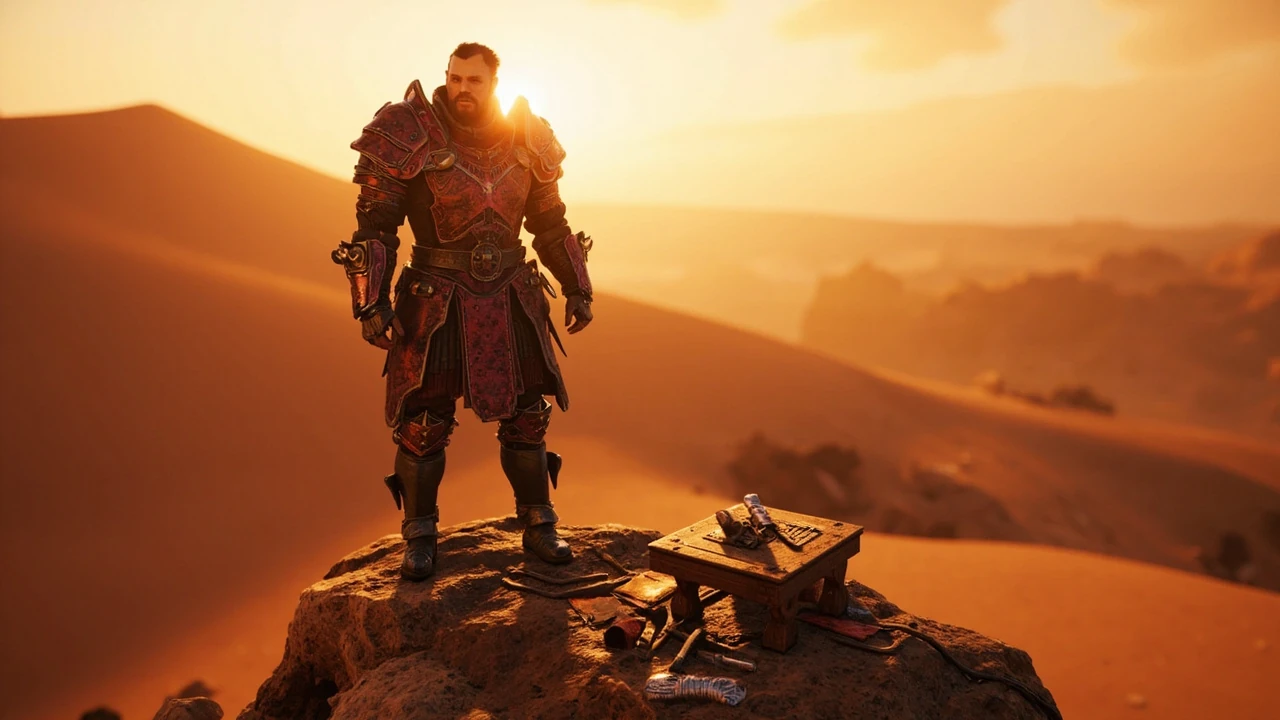
Crimson Desert armor sets: design, progression, and gear choices
Armor in Crimson Desert is not a single wardrobe swap. Pearl Abyss has framed the game as a large-scale action RPG built around open-field combat, mounted travel, and a gear system that visibly changes how a character looks and how they fight. The armor pieces a player chooses sit at the intersection of that visual identity and the underlying stat model, so a clear understanding of how sets are organized, upgraded, and compared saves time during the long mid-game push where most players start to feel the weight of every percentage point of mitigation.
This guide focuses on what a player or production-minded reader can reasonably know about Crimson Desert armor sets from the public materials released so far. It is written for a reader who already understands action RPG conventions such as weight classes, upgrade tiers, and slot-based gear, and who wants a structured look at how the gear system appears to work, what the design intent seems to be, and which decisions matter when a set is being evaluated against another.
How armor fits into Crimson Desert’s combat loop
Crimson Desert places the player in the continent of Pywel and casts them as a Greymane mercenary named Kliff. The developers have described the title as a single-player action RPG with real-time melee combat, mounted combat, and a wide range of traversal mechanics. In that context, armor is one of several systems that compress or expand how a build is allowed to behave. Pearl Abyss has repeatedly framed Black Desert Online as a reference point for action combat, and Crimson Desert’s gear system borrows a number of conventions from that lineage while presenting itself with a more grounded medieval fantasy tone.
Armor in Crimson Desert covers the head, chest, arms, legs, and sometimes secondary pieces such as gloves or boots depending on the slot rules. Each piece contributes defense, weight, and usually one or more stat modifiers. A full set combines the individual contributions of every worn piece and, in many cases, unlocks set bonuses when enough pieces from the same family are equipped. The visual silhouette of the set is meant to communicate at a glance what role a character is built for, and Pearl Abyss has emphasized that armor is designed to be worn, not just inspected, because combat moves, traversal animations, and physics simulation are tied to the equipped mesh.
For production readers, this is an important design decision. Armor is not a single texture; it is a stack of responsibilities that includes silhouette readability, animation compatibility, physics weight, and stat math. The remaining sections unpack each of those responsibilities in turn.
The main armor set families in Crimson Desert
Pearl Abyss has not published a final in-game database of every Crimson Desert armor set, but pre-release coverage, hands-on previews, and the official press kit point to several distinct families. These families group sets by origin, theme, and intended combat role.
- Greymane-issue sets: standard-issue gear that mercenaries wear at the start of the campaign, intended as a balanced baseline.
- Regional sets: armor tied to factions, towns, or biomes within Pywel, often associated with a particular crafting discipline or resource.
- Plate and knight orders: heavy, plated sets that lean toward defense and poise at the cost of stamina and movement speed.
- Scout and ranger sets: lighter, mobility-oriented sets that favor evasion, draw speed, and ranged damage.
- Crafted artisan sets: armors produced through high-tier crafting recipes, usually as the result of a long material grind.
- Boss- and event-tied sets: rare armors earned from difficult encounters, world events, or limited-time content.
These categories are not strict silos. A boss-themed set can share slot types with a regional set, and a piece from one family can sometimes be mixed with another to chase a specific stat line. Pearl Abyss has signaled that mix-and-match is part of the intended progression, and the system appears to reward thoughtful slot-by-slot planning rather than blind full-set chasing.
Armor slots, weight, and stat structure
The slot layout of Crimson Desert armor is consistent with most modern action RPGs, but the stat structure inside each slot is what changes the planning horizon. The following table summarizes the typical structure that previews and official materials describe. Numbers should be read as placeholders that reflect relative relationships, not exact launch values, because Pearl Abyss has reserved the right to tune defense and stat curves before release.
| Slot | Primary role | Common stat contributions | Typical trade-off |
|---|---|---|---|
| Head | Set completion, stat tuning | Defense, resistances, special modifiers | Usually lower defense per piece than chest armor |
| Chest | Largest defensive footprint | Defense, health, elemental resistance | Higher weight cost than lighter pieces |
| Arms | Combat timing and grip | Attack speed influence, parry bonus, defense | Trade stamina efficiency for offensive bonuses |
| Legs | Mobility and stability | Movement speed, evasion, defense | Trade defense for traversal range or vice versa |
| Boots or feet | Traversal and footing | Stamina cost reduction, ground stability | Trade combat stamina for traversal efficiency |
| Accessory slots | Set bonuses, stat build identity | Conditional effects, build-defining modifiers | Set bonus locks the build to a theme |
Weight is a load-bearing variable in the Crimson Desert combat model. Heavier sets tend to reduce stamina regeneration or dodge distance, while lighter sets lower defense but improve reaction time. Players who value mounted combat need a different balance than players who plan to spend most encounters on foot, and the slot system is what lets them chase that balance without abandoning a visual identity entirely.
Defense tiers, upgrade paths, and crafting
Armor in Crimson Desert is not bought once and forgotten. The upgrade pipeline is layered, and each layer has its own material economy. Pearl Abyss has discussed upgrade systems in prior titles and has hinted at a similar multi-stage approach in Crimson Desert, where pieces can be improved, reforged, and ultimately transcended into higher tiers. The general structure most players should expect is summarized in the table below.
| Tier | Typical source | What the upgrade does | Planning note |
|---|---|---|---|
| Base | Starter, vendor, early quest | Provides baseline defense and stat line | Cheap to replace, treat as placeholder |
| Enhanced | Crafting or early boss | Improves defense and unlocks a set bonus step | First meaningful investment |
| Refined | Mid-game crafting, regional quests | Adds stat modifiers, opens secondary set bonus | Defines the build identity |
| Ascended | Rare drops, late-game crafting | Top-tier defense, full set bonus activation | Often the build’s peak |
| Transcended | Endgame, high-difficulty content | Pushes stats past the cap, adds unique modifiers | Reserved for committed progression |
The system resembles a classic upgrade ladder, but the interesting design choice is how the set bonuses are layered. A set is often defined less by its base version and more by what its fully enhanced form does, which means an early game armor set is not the same product as its endgame counterpart. This is one reason a player who commits to a set early on can still invest meaningfully in it for the rest of the campaign.
Set bonuses and how they shape a build
Set bonuses are the second layer of armor identity in Crimson Desert. Each family of armor has a bonus table that activates when enough pieces of that family are equipped, and the bonus table is structured so that a partial set is useful but a full set is transformative. This is a deliberate pacing choice, because it lets players learn the system with two- and three-piece bonuses before they commit to a full identity at four or more pieces.
For example, a typical heavy knight set might offer the following progression:
- 2 pieces: small flat increase to defense, modest bonus to poise damage threshold.
- 3 pieces: unlock a passive that reduces stagger from blocking heavy attacks.
- 4 pieces: a major bonus such as a guard counter window or a conditional shield bash enhancement.
- Full set: an additional unique passive that often defines how the build plays in a boss fight.
Light scout sets tend to follow a different pattern. Two-piece bonuses frequently improve draw speed or reload speed, three-piece bonuses add an evasion or movement bonus, and full-set bonuses can introduce a unique traversal ability or a long-range damage bonus. The pattern is consistent enough that experienced players can read a new set’s intent quickly from its bonus table.
For build planning, the practical advice is to identify the two-piece and three-piece bonuses first, then decide whether the four-piece or full-set bonus is worth the slot cost. Many experienced players run mixed sets that sacrifice the full set bonus in exchange for a higher stat ceiling or a better match to their weapon choice.
How visual design communicates role and tier
Armor in Crimson Desert is designed to read at a distance. A plate set with closed helm, layered pauldrons, and long gauntlets signals a tank or frontline build, while a sleeveless, open-helm set with cloth accents signals mobility and ranged capability. The art team has discussed this approach in interviews tied to Pearl Abyss’ broader design language, and it shows in the silhouette language of the released screenshots.
The visual language also encodes tier. Higher-tier pieces usually add more elaborate trim, additional layered elements, and unique material treatments such as enameled steel or hardened leather. The result is a set that looks heavier, more decorated, and more “finished” as the upgrade ladder climbs. This is a deliberate choice that helps players feel their progression without having to inspect the stat page, and it gives open-world encounters a sense of social reading, since a heavily armored figure in ornate plate is recognizable as a serious opponent from across a field.
From a production perspective, the visual system also has to coexist with the animation system. Heavy pieces change the timing of roll, sprint, and weapon-swing animations, and the physics rig is tuned to reflect that. A heavy chest piece slows the recovery of a dodge, while a light chest piece lets the character pivot faster. This is part of why armor is not just a stat block: it is a series of constraints that the animation team has to design against.
Armor and the mounted combat layer
Mounted combat is one of the defining mechanics of Crimson Desert, and armor interacts with it in ways that are not always obvious from a flat stat comparison. Horses, and possibly other mounts, have their own encumbrance rules, and the rider’s armor weight affects how a mount accelerates, how it turns, and how it recovers from a charge. Lighter scout sets can turn a mount into a fast harasser, while heavy plate sets turn a mount into a slower but harder-to-displace shock cavalry option.
For players who plan to spend a significant portion of the campaign on horseback, the practical takeaway is that armor should be evaluated in two contexts: on-foot combat stats and mounted combat behavior. A set that looks optimal in a duel may feel sluggish during a long pursuit, and the slot system exists precisely to allow that trade-off to be tuned.
From a design standpoint, this also explains why the game places so much emphasis on traversal. Armor is not a static identity, and the developers have built multiple layers of gameplay on top of that variability, which keeps the gear system relevant throughout the campaign rather than only at the very end.
Stat priorities by playstyle
Choosing an armor set without first defining a playstyle is one of the most common mistakes new players make in action RPGs, and Crimson Desert is no exception. The table below summarizes how the most common playstyles typically map to armor priorities, based on the systems Pearl Abyss has described. The “priority” column lists the stat categories a player should look for first when comparing two sets of the same tier.
| Playstyle | Preferred weight | Stat priorities | Armor choice to evaluate first |
|---|---|---|---|
| Frontline tank | Heavy | Defense, poise, block efficiency | Plate and knight order sets |
| Aggressive melee | Medium | Attack power, stamina, poise | Crafted artisan or region sets |
| Ranged harasser | Light | Draw speed, movement, stamina | Scout and ranger sets |
| Mounted rider | Light to medium | Mount stamina, turning, momentum | Ranger or hybrid regional sets |
| Hybrid spell-weapon | Medium | Cast speed, mana, conditional defense | Accessory-heavy mixed sets |
| Exploration-focused | Light | Traversal stamina, terrain bonuses | Scout sets with movement bonuses |
This mapping is not a rule. It is a starting point, and a player who enjoys mixing archetypes can absolutely build a successful heavy-armor ranged set or a light-armor frontline build if the slot-by-slot choices support it. The table is a planning aid, not a doctrine.
Common pitfalls when evaluating armor
Armor evaluation in Crimson Desert is more layered than a pure defense comparison, and several pitfalls are common enough to call out:
- Reading the defense number without considering weight: a heavier set with a higher defense number can still feel worse in practice because of stamina and dodge penalties.
- Chasing a full set bonus that does not match the weapon: many full-set bonuses are tuned around a specific weapon family, and equipping a different weapon reduces the bonus’s effective value.
- Ignoring set completion at lower piece counts: two- and three-piece bonuses are often strong enough to be the real reason a set is worth chasing, even if the full-set bonus is mid.
- Confusing visual tier with stat tier: a heavily decorated set is not always the strongest set, and a plain-looking set can be the better build choice for a long stretch of the game.
- Neglecting upgrade material economy: a set that requires a rare drop for its final upgrade is not equivalent to a set that uses widely available crafting materials, even if their stats at peak are similar.
Each of these pitfalls can be diagnosed by treating the armor comparison as a multi-variable problem rather than a single-number comparison. Players who keep a short list of their real priorities before opening the gear menu tend to make faster, more confident choices.
Crafting, materials, and the economy around armor
Crimson Desert’s crafting system is a major part of how armor enters the player’s hands. Pearl Abyss has described a system that allows players to gather, refine, and craft equipment, with quality rolls and material tiers influencing the final product. The crafting economy is what makes the gear system feel like a long campaign rather than a single purchase decision.
Material tiers generally map to region, monster type, and progression stage:
- Region-rare materials are tied to specific biomes and are usually gathered through exploration, mining, or hunting.
- Monster-rare materials drop from named enemies, minibosses, and open-world elites and tend to gate the highest upgrade steps.
- Event-rare materials appear during world events and are often tied to the limited windows when those events are active.
- Crafting catalysts are reusable items that can be applied during refinement to influence the roll on the final piece.
For planning purposes, the craftable route tends to be the most stable, because the materials are predictable and can be stockpiled. The drop-based route is faster in raw time when luck is good, but it is volatile, and most experienced players build at least one backup set along the craftable route for that reason.
Comparing Crimson Desert armor to its genre peers
Crimson Desert sits in a crowded action RPG market, and the gear system has to justify its existence against titles that players already know well. The table below compares the most visible design choices to those of a few well-known peers, focusing on what is verifiable about Crimson Desert and what is general industry knowledge about the other games. The comparison is intended as a design lens, not a recommendation.
| Design element | Crimson Desert | Generic open-world action RPG | MMO-style action RPG |
|---|---|---|---|
| Slot count | Five plus accessories | Five plus accessories | Five plus extensive accessories |
| Weight class effect | Stamina, dodge, mounted combat | Stamina, dodge | Stamina, cast speed, sometimes cooldowns |
| Set bonus granularity | Two, three, four, full set | Two, three, full set | Two, three, four, six, full set |
| Crafting depth | High, with material tiers and refinement | Moderate to high | High, often with work orders |
| Endgame goal | Transcended tier, full set completion | Unique drops, set completion | Stat caps, enchant stacking |
| Mounted combat interaction | Armor weight affects mount handling | Usually limited or none | Sometimes present, often minimal |
Two design choices stand out. The first is the explicit weight interaction with mounted combat, which is rare in the genre. The second is the relatively gentle set bonus curve, which is closer to a single-player action RPG than to a traditional MMO, where six-piece bonuses and stacking effects are common. Both choices support the game’s positioning as a focused single-player experience with a long but finite progression arc.
For production readers, this is one of the more interesting things to track as the title moves through its post-launch support window. The combat blog and ongoing tuning will reveal whether the developers treat armor as a static campaign system or as a live lever, and how they react when a particular set comes to dominate the meta.
How armor connects to weapons, skills, and traversal
Armor in Crimson Desert does not exist in isolation. A full build is the product of armor, weapon, skills, and traversal tools, and the most common reason an armor set feels disappointing in practice is that it is being evaluated without reference to the rest of the build. The following list is a quick checklist for evaluating a new set in context:
- Confirm that the set’s stat priorities reinforce, rather than fight, the weapon’s scaling and timing.
- Check that the set’s weight class matches the stamina budget of the chosen skill rotation.
- Verify that any conditional bonuses in the set can actually be triggered by the chosen skills or traversal tools.
- Compare the set’s two-piece and three-piece bonuses to the rest of the gear to see whether full-set completion is required or whether mixed gear is stronger.
- Estimate the material cost of the upgrade path and compare it to the time it would take to acquire a comparable set through a different route.
This kind of checklist is not unique to Crimson Desert, but it is especially relevant here because the developers have built multiple systems that interact with armor, including mounted combat and traversal. A set that is strong in a vacuum can be the wrong choice for a specific build, and a set that looks modest on paper can be the right backbone for a hybrid playstyle.
What to watch in the post-launch tuning window
Because Crimson Desert is a live product, the gear system is almost certain to change. Pearl Abyss has a long history of patching its action RPG systems, and the early months of the game are usually the period when balance passes and bug fixes are most aggressive. The following list collects the most important things a serious player or production reader should keep an eye on, without making any claims about what Pearl Abyss will actually do:
- Defense curve changes: even a small percentage change to the defense formula can shift which tier of armor feels mandatory.
- Set bonus tuning: full-set bonuses that overperform are usually the first target of balance passes, and the surrounding pieces can be dragged with them.
- Material economy adjustments: a change in drop rates or crafting costs can move a previously niche set into the mainstream.
- Mounted combat tuning: because armor weight influences mount handling, any change to mount behavior is effectively a change to armor utility.
- New set introductions: the first major patch after launch is the most likely place for an unexpected set to appear, and the meta can shift quickly around it.
For studio leads and producers reading this with a GameDev lens, the takeaway is that the gear system is a public-facing surface that has to remain coherent under constant iteration. The art team has to be ready to support new pieces, the animation team has to handle new weight classes, and the economy team has to keep the material flow realistic. This is the kind of system that benefits from clear internal ownership and a documented tuning philosophy, and it is one of the more interesting things to observe in the game’s early life.
Practical checklist for choosing a Crimson Desert armor set
By this point, the gear system has enough moving parts that a final checklist is useful. This is the kind of routine that experienced players run before they commit to a new set, and it is also a useful pattern for anyone designing similar systems in their own projects.
- Define the playstyle first, then look for the set that supports it.
- Compare two- and three-piece bonuses before comparing full-set bonuses.
- Read the upgrade ladder and confirm that the final tier is reachable within the planned playtime.
- Check the material economy and confirm that the route to the set is stable.
- Test the set in a low-stakes encounter before committing the upgrade materials.
- Re-evaluate the set after each major patch, because the meta can shift quickly.
The last item is worth highlighting. A set that is optimal at launch can be average a month later, and a set that is average at launch can become the new standard after a balance pass. Players who treat their gear choice as a one-time decision tend to over-invest in a single set, while players who treat it as a recurring decision tend to keep their options open and adapt faster.
Frequently asked questions
How many armor slots does a character have in Crimson Desert?
Based on the materials released so far, a character has the standard five main armor slots: head, chest, arms, legs, and feet. Several accessory slots round out the build, and the exact count of accessories is expected to be confirmed at launch. Each slot contributes a distinct set of stats and visual elements, and the full build is the product of every equipped piece working together.
Do armor sets in Crimson Desert have full set bonuses?
Yes. Most major armor families appear to offer layered bonuses that activate at two, three, four, and full set completion. The earlier bonuses are usually modest stat upgrades or conditionals, while the full set bonus tends to be the build-defining effect. The system is designed so that partial sets are useful on their own and full sets are a meaningful long-term investment.
Can armor be upgraded after it is acquired?
Armor in Crimson Desert follows a multi-stage upgrade ladder that includes enhancement, refinement, and what looks like a final transcendence step. Each stage improves the stat line and may unlock additional set bonus levels. The exact material costs and stat increases will be detailed in the in-game system, but the ladder is consistent with the genre’s general structure.
How does armor weight affect combat?
Heavier armor increases defense but reduces stamina efficiency, dodge distance, and sometimes attack speed. Lighter armor is the opposite, with lower defense and better mobility. The exact tuning is one of the most important things to test in the open beta, because the difference between a heavy and a light set is felt most in long encounters where stamina management is the deciding factor.
Does armor affect mounted combat?
Yes. Armor weight is one of the inputs to how a mount handles, including acceleration, turning, and stamina. A heavy set turns a mount into slower, harder-to-displace cavalry, while a light set turns it into a fast harasser. This is one of the more distinctive design choices in Crimson Desert, and it is a major reason that armor cannot be evaluated only on foot.
Can armor pieces be mixed across sets?
Mixing is supported. The set bonus system is structured so that equipping two or three pieces from a family gives a partial bonus, which makes it possible to chase specific stat lines without committing to a full set. Many experienced players are expected to run hybrid sets that trade the full set bonus for a higher stat ceiling or a better match to their weapon.
Are some armor sets tied to specific factions or regions?
Yes. Several families of Crimson Desert armor sets are tied to factions, regions, and biomes within Pywel. These sets often reflect the visual culture of their origin, and their stats tend to support the combat style associated with that faction or region. Faction-tied sets are a common mid-game goal because they combine story progression with a meaningful gear upgrade.
Will the armor system change after launch?
Live games in this genre are almost always tuned after launch, and Crimson Desert is likely to be no exception. Balance passes, new sets, and material economy adjustments are all part of the post-launch cycle. Players who want to stay current should follow the official patch notes and the developer’s community channels, and they should be ready to re-evaluate their set choices after each major update.
Is the visual design of armor consistent with its stat identity?
Yes. Pearl Abyss has emphasized that armor silhouette is meant to communicate role, tier, and origin at a glance. Heavy sets look heavy, light sets look light, and higher-tier sets look more decorated than their lower-tier counterparts. This is a deliberate design choice that helps players read the world around them without inspecting the stat page.
Where can I read more about Crimson Desert’s design choices?
The official Crimson Desert Wikipedia article is a good starting point for the broader project context, and this hands-on review of Crimson Desert provides additional detail on how the systems play in practice. Both sources are useful for readers who want a deeper look at the game beyond the armor system itself.





Leave a Reply