

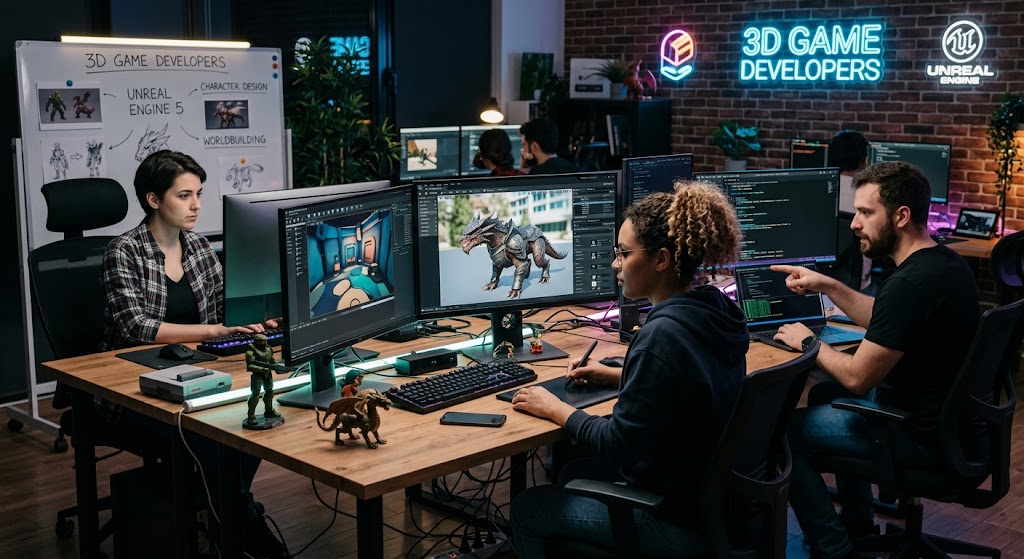
3D Game Developers: Everything You Need to Know About the Craft
Making modern video games is hard work. It takes a unique blend of art, mathematics, logic, and storytelling to pull off a project that people actually want to play. Behind every sprawling open world and every sleek interactive scene, you will find 3D game developers working through complex problems line by line.
The gaming market keeps growing every single year. Players expect realistic lighting, smooth animations, and zero performance stutters. Because of these rising expectations, talented 3D game developers are in high demand across indie studios and major production houses alike.
So, what does this craft actually look like from the inside? Let us break down what these professionals do, how they work, and how you can build a team that gets results.
What Core Technical Skills Do 3D Game Developers Need?
You cannot just jump into interactive design without a solid technical foundation. Modern 3D game developers rely on a robust skill set that spans software engineering, math, and digital artistry.
First and foremost comes programming language proficiency. Most interactive rendering relies heavily on C++ due to its raw execution speed and granular memory management capabilities. C# is equally popular thanks to its position as the primary language for Unity. Scripting languages like Python and Lua also show up frequently for rapid prototyping, tool creation, and pipeline automation.
Math is another massive pillar. Vector calculus, matrix transformations, linear algebra, and quaternions form the backbone of spatial physics, camera movements, and object positioning. If 3D game developers do not understand vector math, high-speed physics calculations instantly crumble.
Here is a quick look at the core technical disciplines involved:
- Engine proficiency across environments like Unreal Engine, Unity, and custom proprietary frameworks.
- Advanced mathematics including 3D vector geometry, quaternions, matrix operations, and dot/cross product calculations.
- Shaders and graphics APIs such as HLSL, GLSL, DirectX, Vulkan, and Metal for custom visual effects.
- Optimization techniques including draw call minimization, level of detail (LOD) systems, and memory profiling.
Beyond these fundamentals, specialized knowledge in graphics pipelines plays a huge role. Understanding how graphics hardware processes data allows 3D game developers to push visual fidelity higher without dropping frame rates.
The table below summarizes the key programming languages commonly used across interactive projects, along with their primary use cases and typical learning curves.
| Language | Primary Engine / Context | Core Advantages | Typical Use Case |
|---|---|---|---|
| C++ | Unreal Engine, Custom Engines | High performance, direct memory control | Core engine mechanics, AAA systems, physics rendering |
| C# | Unity Engine | Fast development cycles, clean syntax | Indie titles, mobile projects, gameplay logic |
| Python | Pipeline Automation, Maya/Blender tools | Simple scripting, rapid iteration | Build systems, asset export validation, pipeline tooling |
| HLSL / GLSL | DirectX / OpenGL / Vulkan Shaders | Direct GPU control, real-time lighting | Custom shader creation, visual effects, lighting models |
Building real-time experiences is rarely a solitary endeavor. Teams must align art assets, audio, logic, and interface elements seamlessly, which makes workflow coordination just as important as code quality.
How Do 3D Game Developers Structure Workflows?
Creating a playable world requires a structured assembly line. If artists, designers, and programmers work in isolation, integration chaos is guaranteed. Successful 3D game developers follow clear pipeline stages to move from concept to final release without breaking the engine.
The journey starts with pre-production. Ideas get prototyped using simple geometric blockouts, often called greyboxing. This stage allows 3D game developers to test player movement, spatial balance, and level pacing before committing expensive art assets to production.
Once greyboxing proves the gameplay loop works, asset creation begins. Artists model assets in DCC software like Maya, Blender, or 3ds Max. These models get unwrapped, textured using tools like Substance Painter, and passed down the line. Riggers create bone structures for characters, while animators bring them to life.
Then comes technical implementation. Skilled 3D game developers import these assets into the target engine, write scripts for interaction, attach physics hitboxes, set up state machines, and fine-tune lighting parameters.
Here are the key stages of an interactive development pipeline:
- Pre-production and greyboxing to prove core mechanics and spatial scale.
- Asset creation, texturing, rigging, and animation export.
- Technical integration inside the engine, wiring logic to visuals.
- Performance profiling, bug tracking, and optimization for target platforms.
Performance optimization happens throughout this entire cycle. If frame rates drop below 60 frames per second, immersion drops with them. Experienced 3D game developers continuously profile memory usage, minimize state changes, and strip out unnecessary polygon counts.
To keep teams running smoothly, choosing the right toolset is essential. Different engines and tools cater to different production sizes and visual goals.
| Tool Category | Industry Standards | Best Suited For | Key Output |
|---|---|---|---|
| Game Engines | Unreal Engine 5, Unity, Godot | Real-time logic, rendering, scene composition | Playable game builds |
| 3D Modeling | Blender, Autodesk Maya, 3ds Max | Geometry creation, UV mapping, character rigging | FBX, OBJ, USD asset files |
| Texturing | Substance 3D Painter, Photoshop | PBR material creation, surface details | Albedo, Normal, Roughness texture maps |
| Version Control | Git LFS, Perforce (Helix Core) | Managing large binary assets and code repositories | Version-tracked production history |
Working through these steps takes patience, discipline, and constant communication. But when every gear turns smoothly, the resulting experience feels effortless to the end user.
Now, let us discuss what to look for when you need to bring these professionals onto your team.
Hiring the right talent is often the difference between launching a successful title and getting stuck in feature creep forever. You need people who can code, solve problems, and collaborate under tight production schedules.
Look closely at portfolio projects rather than just resume lines. A functional gameplay demo tells you much more than a list of theoretical skills. Look for clean frame rates, smooth physics interactions, and well-organized asset structures within their work samples.
Here are key qualities to evaluate when hiring 3D game developers:
- Proven experience with targeted engines like Unreal or Unity on shipped titles or polished indie projects.
- Strong understanding of real-time rendering constraints, asset optimization, and memory budgets.
- Clear communication skills for collaborating across art, sound, and design departments.
- Problem-solving capabilities when debugging complex physics or network latency issues.
Keep these points in mind during technical interviews. Ask candidates how they solved specific performance bottlenecks in past projects. Capable 3D game developers will immediately talk about draw calls, shader complexity, and memory management without hesitating.
Frequently Asked Questions
What Is the Primary Role of 3D Game Developers?
Their primary role is converting creative design ideas, artwork, and logic into playable, interactive real-time environments. They write the software mechanics, integrate visual and audio assets, implement physics systems, and optimize code to ensure smooth performance on target hardware like PCs, consoles, or mobile devices.
Which Programming Languages Do 3D Game Developers Use Most?
C++ and C# are the dominant programming languages in this field. C++ is preferred for high-performance custom engines and Unreal Engine projects due to direct system access. C# is the standard language for Unity development, making it widely popular across indie, mid-tier, and mobile studios.
How Do 3D Game Developers Optimize Performance?
Optimization involves reducing vertex counts, using Level of Detail models, baking static lighting, and batching draw calls. Developers also profile CPU and GPU usage to eliminate frame rate drops, optimize memory allocation, and streamline shader computations for smooth execution across target platforms.
What Is the Difference Between 2D and 3D Game Developers?
2D developers work primarily with flat visual sprites and two-axis coordinate systems (X and Y). 3D developers manage three dimensions (X, Y, and Z), requiring advanced math for vector transformations, spatial audio placement, complex skeletal rigging, dynamic lighting setups, and 3D collision detection.
Which Engine Should Beginners in 3D Game Development Learn First?
Unity and Godot are excellent entry points for beginners due to user-friendly interfaces, extensive documentation, and active learning communities. Unreal Engine is also great, particularly for developers focused on high-end visual fidelity and visual scripting through Blueprints.
Can 3D Game Developers Work Remotely?
Yes, remote work is widely common across indie and major game studios worldwide. Remote production relies heavily on robust version control systems like Perforce or Git LFS, cloud collaboration platforms, and secure remote desktop infrastructure to manage large asset files and project repositories.
How Long Does It Take 3D Game Developers to Make a Game?
Development timelines depend entirely on scope, team size, and complexity. Small indie projects may take six months to two years, whereas massive AAA titles developed by hundreds of team members often take four to six years from pre-production to release.
Building high-quality interactive experiences requires dedication, technical skill, and structured teamwork. Whether you are aiming to build your own title or hire experienced talent to bring your vision to life, understanding the core tools, workflows, and technical demands of modern production sets you up for long-term success in this competitive industry.





Leave a Reply