
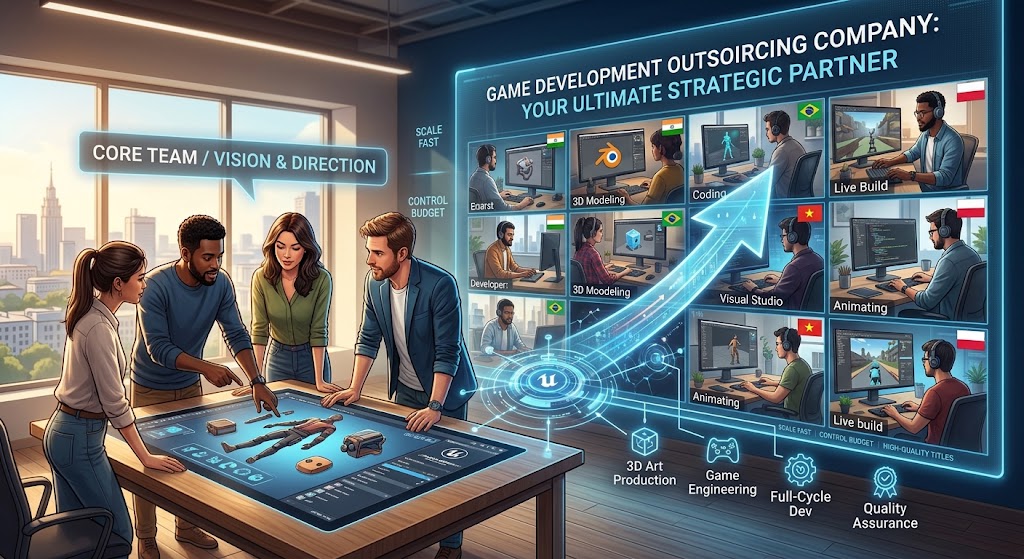
Game Development Outsourcing Company: Your Ultimate Strategic Partner
Building a great video game is tough. Production costs keep going up, player expectations are higher than ever, and finding specialized talent locally can feel almost impossible.
That is where external production teams come into play. Working with a specialized partner allows studios of all sizes to scale faster, control burn rates, and ship titles on time.
Whether you need full-cycle production or quick art support, partnering with a game development outsourcing company gives you immediate access to battle-tested developers, 3D artists, level designers, and QA engineers.
In this guide, we break down how external game production works, how to choose the right partner, and how to manage remote game engineering teams without losing creative control.
Why Choose a Game Development Outsourcing Company for Your Project
Game production timelines are unpredictable. One month you need ten extra 3D environment artists, and six months later you need senior network programmers for backend optimization.
Hiring full-time staff for short project spikes creates massive overhead. It takes months to recruit, onboard, and integrate new engineers or animators into your pipeline.
When you collaborate with a professional game development outsourcing company, you bypass the slow hiring loop entirely. You gain immediate talent flexibility.
Here are the primary reasons game publishers and independent studios rely on external teams today:
- Rapid team scaling without long-term employment liabilities or costly severance packages.
- Access to rare niche expertise in engines like Unreal Engine 5, Unity, and custom proprietary engines.
- Significant cost reduction on payroll, hardware licenses, software suites, and studio space.
- Round-the-clock development schedules using cross-border time zone overlaps.
Look at how top studios operate today. Almost every major AAA project relies on global external teams for environment art, rig animations, character design, quality assurance, and audio engineering.
It is not just about saving money anymore. It is about keeping your core studio focused on creative direction while operational partners execute massive asset production pipelines.
Services Offered by a Top Game Development Outsourcing Company
External game studios provide end-to-end capabilities tailored to specific project milestones. You do not have to hand over your whole project unless you want to.
Some teams require simple art support, while others need full co-development where the external unit builds entire game systems from scratch.
The matrix below outlines the standard service models available when you hire a game development outsourcing company for PC, console, or mobile titles.
| Service Model | Primary Focus | Best Suited For | Key Deliverables |
|---|---|---|---|
| Full-Cycle Development | End-to-end production from concept to launch | Startups, publishers, non-gaming brands | Playable title, backend systems, store launch |
| Co-Development | Joint engineering and content creation | Mid-sized and AAA studios needing speed | Engine features, physics systems, levels |
| Staff Augmentation | Individual specialists joining your internal team | Studios missing key technical roles | Dedicated programmers, animators, QA leads |
| Art & Animation Production | Visual asset creation and rigging pipelines | Projects requiring massive visual assets | 3D models, textures, concept art, UI/UX |
Choosing the right engagement model depends heavily on where you are in your production lifecycle. Early pre-production usually benefits from staff augmentation or specialized art concepting.
Later stages often call for dedicated QA squads, porting experts, and backend server load testers to ensure launch stability across Steam, PlayStation, Xbox, and Nintendo platforms.
A reliable game development outsourcing company works as an organic extension of your team, fitting directly into your Jira workflows, Slack channels, and version control systems.
Core Advantages of Outsourcing Game Production
Cost efficiency gets all the attention, but technical flexibility is the real benefit. Game engines evolve rapidly, and maintaining in-house expertise across all specialized fields is nearly impossible.
For instance, switching from Unreal Engine 4 to Unreal Engine 5 requires deep knowledge of Nanite, Lumen, and Chaos physics. Training your existing team can delay production by months.
External partners maintain pre-trained specialists who already know these tools inside out. They hit the ground running on day one.
Here is what you gain when expanding your team externally:
- Faster time-to-market by running parallel production tracks for art, programming, and QA.
- Lower capital expenditure on high-end developer workstations, VR equipment, and devkits.
- Reduced operational risk during unexpected budget adjustments or game delays.
- Fresh creative perspectives on game mechanics, level design, and user experience.
And let us talk about risk mitigation. If a feature prototype fails during pre-production, scaling down an external contract is simple and clean compared to handling internal layoffs.
This agility allows game leads to experiment more aggressively with innovative gameplay mechanics without taking on permanent financial risks.
Comparing In-House Teams and External Production Partners
Should you build everything internally or partner with an established team? There is no single correct answer, but comparing the operational costs helps make things clear.
Building an in-house team gives you total control over culture and daily focus. However, it costs significantly more and takes considerably longer to adjust when scope changes happen.
The table below compares the key practical differences between internal hiring and hiring a game development outsourcing company.
| Evaluation Criteria | In-House Development Team | External Outsourcing Partner |
|---|---|---|
| Time to Onboard | 3 to 6 months per key hire | 1 to 3 weeks for full teams |
| Recruitment & HR Overhead | Very High (Internal recruiters, benefits, workspace) | Zero (Handled by the partner company) |
| Technical Skill Breadth | Limited to hired internal staff capabilities | Vast talent pool across multiple domain areas |
| Scalability Speed | Slow and expensive to adjust size | Instant ramp-up or ramp-down based on contract |
| Long-term Financial Commitment | High fixed operational expenditure (OpEx) | Flexible, contract-based project expenditure |
Most successful gaming companies do not choose just one model. They build a tight, highly skilled internal core team that manages IP and game direction, while leveraging external vendors for mass execution.
This hybrid approach combines the deep brand passion of internal creators with the raw speed and scale of global engineering studios.
Key Factors to Evaluate Before Hiring an External Studio
Not all development vendors are equal. Picking the wrong partner can lead to delayed launches, broken code bases, misaligned visual styles, and endless communication headaches.
Before signing any contracts or transferring code repositories, you need to thoroughly vet prospective vendors on concrete technical criteria.
Follow these essential vetting steps during vendor selection:
- Review past playable games and shipped titles, paying close attention to performance optimization.
- Assess communication protocols, English fluency, time zone overlaps, and project management tools.
- Verify intellectual property protections, strict non-disclosure agreements, and code security standards.
- Start with a small, paid test milestone before assigning major production pipelines.
Look at their historical track record in your specific genre. A studio that excels at mobile casual games might struggle with complex C++ systems required for multiplayer PC simulation titles.
Demand clarity on technical documentation practices, unit testing, continuous integration setup, and code ownership rights from day one.
Transparent communication is critical. If a partner is upfront about technical risks during early discussions, that is a huge green flag for long-term collaboration.
Managing Remote Game Production Pipelines Efficiently
Once you hire an external partner, clear communication keeps the project running smoothly. Managing distant teams requires clear guidelines and strict milestone trackings.
Treat your external partner like an extension of your own floor, not a black box where you drop tasks and pray for good results weeks later.
Establish daily standups using Slack or Discord. Set up clear task backlogs in Jira or Trello with granular acceptance criteria for every single ticket.
Use modern source control systems like Perforce or Git with LFS so everyone works on live build revisions without version collision issues.
Regular playable builds are essential. Never wait until the end of a sprint to test progress-play test code integrations weekly to catch bugs and mechanical mismatches early.
When expectations are clear, remote teams deliver exceptional results that rival or beat internal production speeds every single time.
Frequently Asked Questions
What Services Does a Game Development Outsourcing Company Provide?
An external studio provides full-cycle game creation, co-development, 2D and 3D art production, character animation, UI/UX design, game engine porting, C++ and C# engineering, audio creation, and full QA testing.
How Much Does It Cost to Hire an External Production Team?
Costs vary widely depending on geography, specialized skill requirements, and scope. Hourly rates generally range from $25 to $150 per hour depending on region, talent seniority, and technical complexity.
How Do Studios Protect Intellectual Property When Outsourcing?
Reputable partners sign strong non-disclosure agreements and master service contracts before work starts. These legal agreements guarantee that all code, assets, audio, and design concepts remain 100 percent your exclusive property.
Can Small Indie Studios Benefit from Production Outsourcing?
Yes, indie studios frequently use external partners to fill skill gaps. It lets small teams access high-end 3D art, complex shader creation, or specialized porting without hiring expensive full-time senior staff.
What Game Engines Do External Development Teams Support?
Most professional studios work extensively in Unreal Engine 4 and 5, Unity, and Godot. Many senior engineering vendors also work directly with custom, proprietary studio engines written in C++ or C#.
How Do You Maintain Quality Control with an External Vendor?
Quality control is maintained through detailed visual style guides, strict code review protocols, automated unit testing pipelines, clear acceptance criteria on Jira tickets, and frequent playable milestone builds.
What Is the Difference Between Co-Development and Full Outsourcing?
Co-development means the external team works alongside your internal engineers on shared features. Full outsourcing means handing an entire project module or whole game title to the vendor for end-to-end execution.
Partnering with a reliable game development outsourcing company gives your studio the speed, technical flexibility, and cost control needed to succeed in today’s competitive gaming landscape. By setting clear expectations, choosing experienced vendors, and managing pipelines transparently, you can consistently deliver world-class gaming experiences on schedule and within budget.





Leave a Reply