

Crimson Desert reviews: what players and critics are saying
The first wave of Crimson Desert reviews describes a game that technical outlets find visually extraordinary and mechanically ambitious, yet structurally uneven. Multiple major outlets agree on the same handful of points: the seamless open world is unusually striking for a single rendered location, the melee combat grows deep once skills unlock, and the optional reunion of the Greymane faction provides the campaign’s only real emotional anchor. Critics also converge on shared frustrations around story clarity, inventory friction, base-clear pacing, and bosses that punish exploration with strict arena limits. That consensus is useful for prospective buyers because it lets you weigh the praise and complaints against the kind of experience you actually want from an open-world action RPG.
This article is written for players, developers, and writers tracking the launch conversation. It consolidates what established outlets are reporting, places those observations in a game development context, and flags where the design choices appear intentional versus accidental. Where a claim depends on a specific outlet’s review copy, the source is named so the evidence can be checked directly.
What the major Crimson Desert reviews agree on
Across early critical coverage, the pattern is consistent: a strong technology showcase, an exploration loop that genuinely rewards curiosity, and a campaign that struggles to give any of it narrative weight. Game Informer’s review frames the entire experience as a brothy “Clear Soup,” beautiful and filling on the surface but lacking depth of flavor beneath. The shared observations from other outlets land in roughly the same places, and the overlap is significant enough that the recurring complaints are unlikely to be a single reviewer’s taste.
That overlap is also useful when read through a production lens. The recurring praise lines up with systems that benefit from a unified world, large budgets of authored content, and engine-level rendering work. The recurring complaints line up with systems that depend on tighter tuning, clearer feedback, and shorter feedback loops. Both halves of that balance tend to be visible in launch coverage for big open-world releases, and Crimson Desert fits the pattern.
How the open world is being described
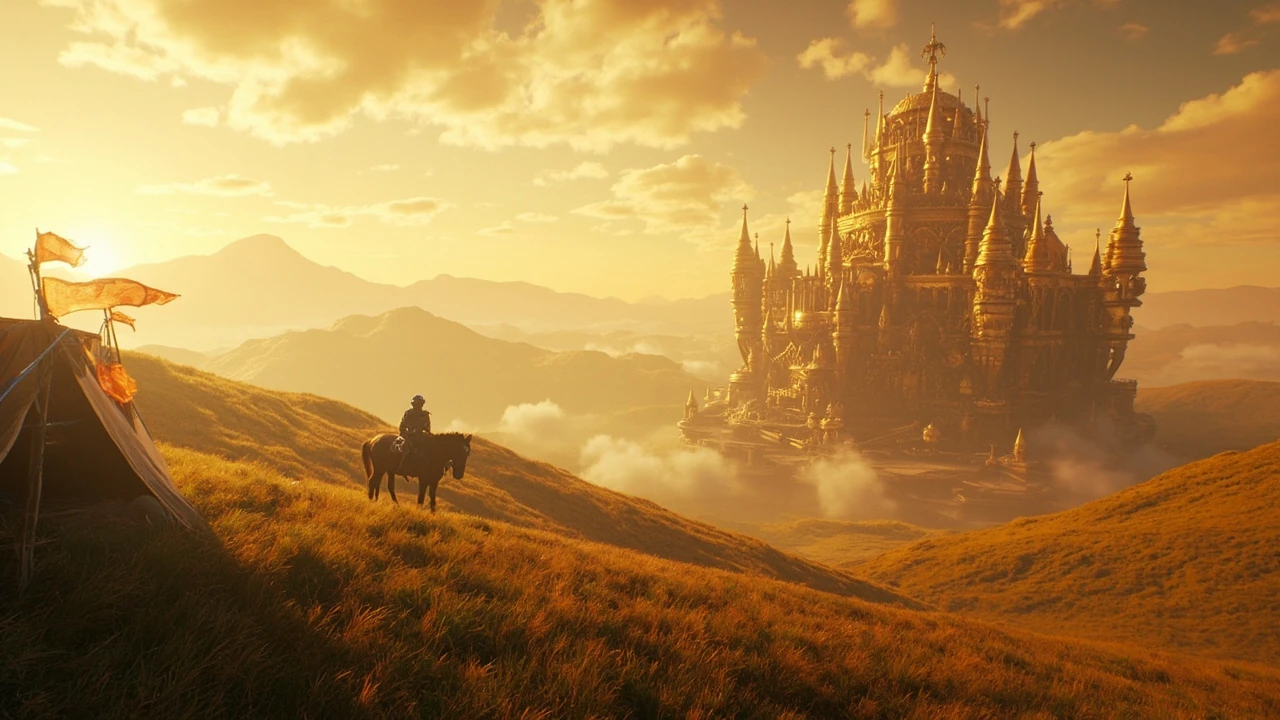
Every published review that examines the world directly treats it as the headline feature. The continent of Pywel is rendered as a single connected location, with high vantage points revealing almost the entire map at once. Critics describe clockwork cities, floating ruin labyrinths, and small cultures tucked into the geography that reward off-path riding. That sense of a “real place” rather than a stitched-together series of zones is the single most consistent positive thread across early Crimson Desert reviews.
From a game development standpoint, a fully continuous open world is a significant rendering and streaming commitment. It is also the reason several outlets compare the world to Breath of the Wild and Dragon’s Dogma, not because the games share a setting, but because both predecessors treat environmental discovery as a core verb. Crimson Desert is being described in the same lineage because the review copy emphasizes discovery over signposting, with very few tutorials and no fast travel until the player finds points for it.
The trade-off is also visible. The same review that praises the world flags that riding between quests can take twenty to thirty minutes in the early game, and that some fast travel points only unlock after the player solves a puzzle first. That is a deliberate friction choice, and it is the most common point of friction in player reactions as well.
Story, characters, and the Greymane hook
The narrative reception is the sharpest split in Crimson Desert reviews. Outlets describe the main plot as a series of spectacle-driven set pieces with weak connective tissue, comparing the structure unfavorably to a “best moments” compilation without the character development that would give those moments weight. The protagonist Kliff is described as effectively a silent protagonist for most of the runtime, and the central conflict with dark forces is described as hard to follow in places.
One section is repeatedly singled out as the exception: the reunion of the Greymanes, the band of allies the player rebuilds through camp activities and side content. Several reviews describe that arc as the campaign’s only real emotional core, and explicitly note that the game makes a significant portion of it optional around the one-third mark. That is a meaningful design observation, because it means a player who skips the optional Greymane content is also skipping most of what the story does well.
For a player deciding whether to read Crimson Desert reviews as a buying signal, the practical takeaway is simple: if narrative satisfaction matters to you, the campaign on its own will not deliver it. The story is carried by side content, faction building, and emergent moments in the world rather than by a tightly scripted main line.
Combat and boss design according to critics
Combat coverage is more divided. The early hours are widely described as tedious because the player does not yet have the skill set that makes the system sing. Late-game combat, once abilities unlock, is described as genuinely deep and expressive, including absurd wrestling moves layered on top of the standard melee kit. The catch is the same one several reviews point out: with more than a dozen combat buttons to manage, fights get messier rather than cleaner as more options open up.
Boss design is the most negatively reviewed system. The recurring complaints are wide, sweeping attack hitboxes, narrow arena boundaries that trigger a “return to the battle area” warning if the player steps slightly out of position, and a difficulty curve that depends on whether the player has been upgrading through Abyss artifacts and resource grinding. A few bosses can apparently be trivialized with a specific gimmick, which makes the difficulty of the rest feel arbitrary by comparison.
For developers reading the coverage, the combat section is essentially a tuning brief. Enemy density, execution animation length, healing economy, and arena size all interact, and the early coverage suggests they are tuned for a different player progression curve than the one most casual players will actually walk.
Inventory, healing, and the time economy
Healing is tied to food, and food requires either gathering or cooking at a bonfire. For additional context, Several reviews call this out as the single design choice that most affects the rest of the experience, because it forces a constant loop of resource gathering between fights, especially before boss encounters. Cooking is a meaningful system in its own right, but its role as the only healing source is what makes it feel mandatory.
Inventory limits compound the loop. Several outlets describe making frequent trips back to towns or the camp to unload items, and describe quest rewards that are often inventory slot expansions rather than story beats. When a fast travel point only unlocks after a puzzle is solved, the round trip can stretch long enough to break immersion.
The total playtime of the early review runs lands at roughly 100 hours, which several critics note is closer to 50 to 60 hours of necessary content wrapped in padding. For players, the practical read is that the time economy is the central design decision you are buying into, not just one feature among many.
Side content and the “everything game” problem
One of the most repeated phrases in Crimson Desert reviews is some version of “wants to be everything.” Outlets list base building, soldier management, melee combat with wrestling moves, realistic physics, puzzle solving, relationship systems with NPCs and animals, hundreds of side quests, and dragon riding as separate systems that all coexist in the same world. The breadth is treated as both a strength and a structural weakness, because no single system is given the room to fully mature.
For an open-world game shipping in 2026, this is a familiar risk. A game that lists this many verbs usually has at least one verb that is undercooked, and the early coverage suggests that “undercooked” is exactly the word reviewers reach for. The systems that come in for the most positive treatment are the ones tied to the world, exploration, and faction building, which is also where the most authored content seems to live.
What Crimson Desert reviews tell game developers
Read as a development retrospective rather than a buyer’s guide, the critical coverage highlights several repeatable lessons. A unified open world is a major technical achievement, but the systems layered on top of it need their own tuning passes independent of how the world is rendered. A game that depends on discovery as a verb has to be honest about how much friction the player can absorb before discovery turns into a commute. Optional content that carries the emotional core has to be visibly optional in a way that does not punish the player for missing it. Boss design needs a consistent difficulty contract across the entire roster, not a mix of gimmick fights and slog fights.
The Greymane camp loop is the strongest validation of a design choice in the coverage. Several reviews describe watching the camp grow as the campaign’s most satisfying progression arc, and the bonding moments with named allies are the parts of the story that actually land. That is a useful signal for any team weighing how to weight scripted narrative against systemic, player-built relationships.
Where Crimson Desert reviews disagree
The points of disagreement are smaller than the points of agreement, but they matter. Some reviewers weight the spectacle and exploration heavily enough that the story and inventory issues read as acceptable trade-offs, while others treat those issues as load-bearing complaints. A few outlets emphasize the late-game combat depth as a reason to keep playing, while others describe the early hours as a wall the game does not earn the right to build.
For prospective players, that disagreement is useful. It tells you that how the game is received depends heavily on how much you value a continuous open world, how much friction you can tolerate in travel and inventory management, and whether you read long playtimes as value or as padding. The same game is being recommended, qualified, and declined in roughly equal measure, which is itself a meaningful signal.
Technical performance and stability notes
Across the early Crimson Desert reviews, performance coverage is the section most likely to depend on platform and patch day. The visual quality of the world is treated as a clear technological achievement by every outlet that comments on it, with the single rendered continent cited as the headline feature. The full render path, frame rate targets, and stability behavior on specific platforms are not consistently documented in the available review copy, so a hardware-specific decision should wait for platform-tested coverage closer to launch.
If you are a developer reading the technical side of the coverage, the relevant detail is that the world is treated as a single authored space rather than a stitched set of zones. That is a real engine and streaming commitment, and the fact that outlets describe the whole map as visible from high vantage points is itself a sign of how the streaming and LOD work has been designed.
Quick buyer signal from early Crimson Desert reviews
- You will probably like Crimson Desert if a continuous open world with real environmental discovery is the single feature you care about most, and if you are willing to grind resources, cook food, and ride long distances between objectives.
- You will probably tolerate Crimson Desert if you enjoy deep late-game combat with a large ability set, can live with inventory friction, and treat the Greymane camp loop as the actual story.
- You will probably bounce off Crimson Desert if you want a tightly scripted main campaign, a clear stat or leveling system to plan around, or boss fights with generous windows and forgiving arenas.
Feature coverage at a glance
The table below summarizes how the major systems are being received in early Crimson Desert reviews. Read it as a snapshot of the launch conversation rather than a final score, since individual reviews continue to publish as more platforms are tested.
| System | Common praise | Common complaint | Reviewer consensus |
|---|---|---|---|
| Open world | Seamless continent, striking vistas, strong sense of place | Long rides between quests, limited fast travel | Net positive, with travel friction acknowledged |
| Main story | Spectacle set pieces | Hard to follow, thin character work, weak emotional payoff | Net negative on its own |
| Greymane camp loop | Most satisfying progression arc in the game | Becomes optional around the one-third mark | Strongest narrative hook |
| Early combat | Frenetic melee feel | Tedious before abilities unlock | Slow start |
| Late combat | Deep, expressive skill kit | Too many button inputs, fights get messier | Rewarding but cluttered |
| Boss design | Some genuinely challenging fights | Wide hitboxes, strict arenas, mixed difficulty | Most negative system in coverage |
| Healing and food | Cooking is a real system | Forces constant gathering between fights | Polarizing by playstyle |
| Inventory and gear | Quest variety | Limited slots, frequent unload trips | Friction noted across reviews |
| Side content | Hundreds of contained stories and systems | Some systems feel undercooked | Net positive with caveats |
| Technical rendering | Single connected world, visual marvel | Platform-specific performance varies | Headline strength |
System comparison: where Crimson Desert reviews land
The table below compares the systems most discussed in early Crimson Desert reviews against the experience they tend to produce, so the trade-offs are visible side by side rather than buried in prose.
| System | What the player does | Time cost | Reward on success | Risk on failure |
|---|---|---|---|---|
| Exploration | Rides the world looking for points of interest, puzzles, and side content | High, especially before fast travel unlocks | Abyss artifacts, fast travel points, world moments | Long return trips if a puzzle is left unsolved |
| Combat encounters | Fights groups of enemies and named bosses | Medium, with execution animations adding up | Loot, ability unlocks, base control | Food and resource burn, repeated attempts on tough bosses |
| Base and camp | Rebuilds the Greymane faction, manages soldiers and camp upgrades | Medium, gated by story progression | Story beats, ally bonding, faction growth | Skipping optional content locks out the emotional core |
| Cooking and healing | Gathers ingredients, cooks at bonfires, manages food inventory | High across a full play session | Sustained healing for tougher fights | Runs out of food mid-fight, then has to grind |
| Inventory management | Decides what to carry, when to return to town or camp | Constant background cost | Slot upgrades, quest items, gear | Frequent unload trips, lost carrying capacity |
| Trading and banking | Engages with the in-world economy | Variable | Resource smoothing, gear upgrades | Underdocumented in early coverage |
How to weigh the praise and the complaints
The cleanest way to read Crimson Desert reviews is to sort the praise and complaints by the kind of player who is most likely to feel each one. Praise for the open world and exploration is structural, meaning it shows up in every review regardless of platform or playstyle. Complaints about inventory and travel are also structural, and they show up just as consistently. Praise for late-game combat is conditional on the player being willing to push through the early hours, and complaints about boss design are conditional on the player engaging with the optional Abyss artifact grind.
That is why the same game gets recommended, qualified, and declined in roughly equal measure. The structure rewards a specific kind of patient, exploration-driven player, and the friction is real for everyone else. Reading the reviews through that lens gives you a sharper buying signal than any single score.
What to watch for in follow-up coverage
- Platform-specific performance numbers on the same single rendered continent, since the visual headline depends on streaming holding up across hardware.
- Confirmation of how optional the Greymane content actually is, and whether the emotional arc survives a player who skips it.
- Patch notes on boss arenas and healing economy, since these are the systems most consistently criticized in launch coverage.
- Long-run coverage of trading and banking, which early reviews flagged as underdocumented.
- Comparison pieces against Breath of the Wild and Dragon’s Dogma that go deeper than surface-level inspiration.
Frequently asked questions
What do Crimson Desert reviews say about the open world?
They describe it as a single, continuous continent rendered as one location, with striking visual variety, a clockwork city, floating ruins, and small cultures that reward off-path riding. The world is treated as the headline feature, with exploration rather than tutorials carrying the player forward.
How is the story received in Crimson Desert reviews?
Critic reception of the main story is negative on its own. Reviews describe a hard-to-follow plot, weak character work, and spectacle-driven set pieces without emotional payoff. The Greymane camp loop is consistently singled out as the campaign’s strongest narrative element, and several outlets note that it becomes optional about a third of the way through.
Is the combat in Crimson Desert good?
Early combat is described as tedious before abilities unlock, and late combat is described as deep and expressive but cluttered with more than a dozen button inputs. Boss design is the most negatively reviewed combat system because of wide attack hitboxes, narrow arenas, and inconsistent difficulty.
How long does it take to finish Crimson Desert?
Early review runs land at roughly 100 hours, which several critics describe as closer to 50 to 60 hours of necessary content wrapped in intentional padding from gathering, travel, and quest design.
Does Crimson Desert have fast travel?
Yes, but it is unlocked through exploration. Some fast travel points are tied to solving puzzles, and the puzzle has to be solved before the point is available. Several reviews note that this turns some return trips into long rides.
How does healing work in Crimson Desert?
The only healing source is food, either carried in the inventory or cooked at a bonfire. Bosses drain food quickly, which forces a constant loop of gathering and cooking between fights, and is one of the most repeated friction points in the reviews.
How does Crimson Desert compare to Breath of the Wild and Dragon’s Dogma?
Reviewers compare it to those games on design language, not setting. The shared traits are minimal tutorials, exploration-driven discovery, puzzle solving with environmental skills, and a focus on what the player chooses to engage with rather than a tightly scripted main line.
Are Crimson Desert reviews generally positive or negative?
They are mixed, with a clear lean toward qualified positive on the open world and exploration, and clear negative on story, inventory friction, and boss design. The same game is being recommended, qualified, and declined in roughly equal measure, which is itself a meaningful buying signal.
Should developers read Crimson Desert reviews for production lessons?
Yes, particularly on the trade-offs between a unified open world and the systems layered on top of it, the cost of treating optional content as the emotional core, and the tuning contract a boss roster needs to deliver across the entire game rather than a handful of standout fights.
Where can I read the most detailed Crimson Desert review?
The most detailed early critical piece on the launch conversation is Game Informer’s Open-World Overload review, which walks through the world, story, combat, inventory, and pacing in depth. It is also the source most of the launch consensus points above are drawn from.





Leave a Reply