

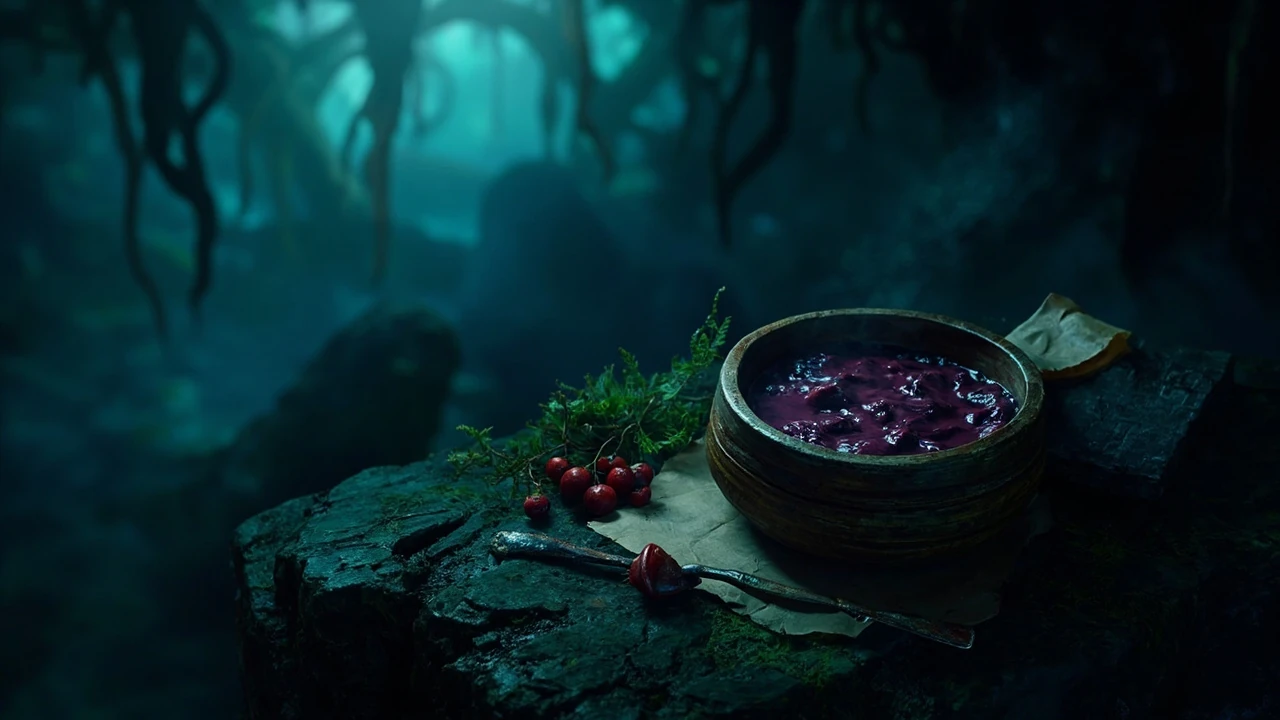
Mossberry stew in Hollow Knight: Silksong
Mossberry stew is the first ingredient that the Moss Druid hands over for The Great Taste of Pharloom quest in Hollow Knight: Silksong, and the recipe in the Moss Druid’s small kitchen in Mosshome becomes the entry point for the entire five-part collection. Players who reach Mosshome above Bone Bottom can complete a short side activity called Berry Picking, return to the Druid, and receive a bowl of pre-made stew without cooking it themselves, which makes it a useful anchor for learning how the game’s larger cooking chain actually works.
This article focuses on that practical path: where Mosshome sits on the map, what triggers the Berry Picking handoff, how the stew behaves as a quest item, and what changes once the player has it. It also looks at how a dish in Silksong is designed from a production standpoint, because stew functions as a template that the other four Pharloom ingredients follow. Players who understand mossberry stew’s structure tend to find the rest of the quest faster and waste fewer cycles backtracking through the Marrow.
Where mossberry stew fits in The Great Taste of Pharloom
The Great Taste of Pharloom is a five-ingredient collection quest. The first and most accessible entry is mossberry stew, which the Moss Druid in Mosshome hands to the player after a short delivery task. The other four ingredients are gathered from different parts of the map, and each one asks the player to learn a new regional mechanic, which is why the developers placed the stew first.
The quest line doubles as a tutorial. Players who already understand how a generic fetch quest works in a Metroidvania will still need to learn how Silksong handles cooking, because the game does not use a workstation. Each ingredient is acquired in a specific way, and the stew is the simplest possible pattern: an NPC trades it for the outcome of a tiny side quest, and no crafting station is involved.
Mechanically, the stew works like a key item rather than a consumable resource. Players cannot eat it for healing, cannot stack it, and cannot sell it. Its only purpose is to mark one slot in the five-ingredient set required to unlock the quest’s final reward. Treating it as a quest token rather than a food item helps players avoid the most common mistake: returning to the Druid expecting the stew to refill or to behave like a potion.
How to reach Mosshome from Bone Bottom
Mosshome sits above and to the east of Bone Bottom, which puts it on the same general plateau as the Marrow entrance. The path climbs through the lower reaches of Mosshome before opening into a small Druid settlement lit by glowing moss. The area is intentionally designed as an early-game hub so that the player can return to it several times during the first act without needing advanced traversal tools.
From Bone Bottom, players generally leave through the upper eastern passage that leads into the Marrow. The Marrow itself is a transitional zone that connects several plateaus. The Mosshome exit sits near the top of the Marrow, where the dripping walls give way to a quieter, plant-filled cavern. Once inside Mosshome, the player follows a short path east past hanging vines until the Druid’s stone cooking area becomes visible.
Because Mosshome functions as a soft checkpoint during early exploration, players rarely need to fight a boss to reach it. The platforming sections are short and forgiving, which matches the role of the area as a tutorial anchor. The first trip into Mosshome is also a good moment to learn how the game’s fast-travel system works, because most of the later ingredient trips will start from this same region.
Berry Picking: the small quest that unlocks the stew
The Moss Druid will not hand over the stew until the player has finished a short side task called Berry Picking. The task is intentionally small: the player collects a handful of mossberries from a nearby patch, returns them, and the stew is the reward. It is a tutorial pattern rather than a puzzle, but it still teaches a few systems that matter for the rest of The Great Taste of Pharloom.
First, it teaches the player that the Druid is a vendor-style NPC whose inventory changes with quest progress. Before Berry Picking, the Druid trades small consumables; after Berry Picking, the stew slot in the conversation opens up. This shift is consistent with how several other vendors in the game handle milestone unlocks, and it is a useful piece of information for players who plan to come back to the same vendor later in the run.
Second, Berry Picking introduces the mossberry as a generic world object rather than a quest token. Players learn to look for the small red clusters growing near walls and roots because the same plants reappear throughout the region. Several of the later ingredients reuse this pattern, where a plant or mineral node looks decorative until a quest makes it valuable.
Third, the side task demonstrates how Silksong gates small rewards behind simple acts of attention. There is no combat check, no platforming challenge, and no hidden requirement. Players who skip the area because it looks like a dead end will miss the stew, but they will not be locked out of the quest. The other four ingredients remain available, and the stew can be picked up later on the same path.
Step-by-step path to mossberry stew
- Travel from Bone Bottom into the Marrow using the upper eastern exit. The Marrow acts as the central vertical corridor of the early game, and players pass through it on the way to several other plateaus.
- Climb through the Marrow until the environment shifts to moss-covered walls and softer lighting. This transition marks the entrance to Mosshome, and the path narrows into a more linear route as a hint that the area is small.
- Follow the path east until the Moss Druid’s stone hearth becomes visible. The Druid usually stands near a low cooking surface, which is where the stew bowl sits once the reward is granted.
- Speak to the Moss Druid. The first conversation introduces the Berry Picking task and explains what to collect. Players should not leave the conversation mid-line, because the quest trigger happens at the end of the dialogue rather than the start.
- Collect mossberries from the cluster directly behind the Druid’s hearth. The cluster is small and visible from the quest-giver’s position, so players rarely need to backtrack far.
- Return to the Moss Druid and complete the dialogue. The stew appears in the inventory, and the Great Taste of Pharloom quest updates with the first ingredient collected.
- Open the quest log and confirm that the mossberry stew entry is now marked. Because the stew is a key item and not a stackable resource, the log shows it as a single acquired ingredient rather than a count.
The path is short on purpose. By the time players reach the Druid, they have already learned how the Marrow’s map system works, and the stew reward confirms that pattern before the quest asks them to go further afield.
What mossberry stew does in the inventory
Once acquired, mossberry stew is held as a key item with a unique icon. It cannot be consumed for healing or for any buff. The inventory entry does not include a count, because the game tracks it as a flag rather than a stack. Players will not find a second copy in a chest or in a vendor’s stock, which is one of the more common points of confusion for players who keep exploring Mosshome after the quest step.
| Attribute | Behavior in the inventory | Why it matters for Great Taste of Pharloom |
|---|---|---|
| Item type | Key item, no stack | Acts as a quest flag, not a resource |
| Consumable | No | Cannot be eaten, sold, or dropped for a benefit |
| Quest marker | Updates Great Taste of Pharloom | Reveals the next ingredient slot in the quest log |
| Drop on death | No, the stew stays in the inventory | Players do not need to recover it after a defeat |
| Re-acquisition | Possible only if the quest is reset | Backups are unnecessary on a normal save file |
The simplest mental model is that the stew is a checkbox. Once the box is checked, the player can move on to the next ingredient. Holding onto the stew in the inventory does not produce any extra effect, and dropping it intentionally is not possible from the standard menu, which protects players from accidentally removing their own quest progress.
Common mistakes when hunting mossberry stew
Even though the path is short, players still run into predictable errors. A few patterns show up often enough that they are worth naming, because the same patterns also affect the rest of the Great Taste of Pharloom chain.
- Skipping the Berry Picking dialogue. The stew is not awarded automatically when the player reaches the Druid. The quest trigger sits at the end of a specific conversation branch, and closing the menu early leaves Berry Picking in an unresolved state.
- Confusing the stew with a consumable. Some players expect the bowl to behave like a healing item from earlier entries in the series. It does not. The stew exists only to mark the first slot in the quest.
- Looking for a second bowl. The quest gives a single copy, and there is no second bowl in the Druid’s area. Returning to the hearth to grab another will not work, and the Druid’s stock does not rotate.
- Heading to the wrong region of Mosshome. The Druid’s hearth sits at the eastern edge of the area. Players who wander west or into the deeper caves have usually entered a different sub-region that does not contain the quest giver.
- Abandoning the quest too early. The Great Taste of Pharloom does not fail when the player takes a long break. Players can leave Mosshome, complete other content, and return to the Druid later without losing the stew or the rest of the chain.
Avoiding these errors saves roughly a single round trip. That might sound minor, but the rest of the quest requires longer detours, and the time saved on the first ingredient compounds across the chain.
What the stew tells us about Silksong’s cooking design
Cooking in Silksong is not centered on a workstation. There is no shared kitchen, no recipe book, and no list of ingredients that the player assembles at a bench. Instead, each dish is acquired from a specific NPC, in a specific way, after a specific micro-quest. The player never needs to combine items in the inventory, and the resulting dish is always a key item rather than a stat booster.
This design choice has several practical consequences. It removes the usual crafting puzzle, where the player has to track which ingredients go into which recipe. It also removes the inventory weight problem that often comes with large crafting chains, because each dish is a single slot. The trade-off is that the player must remember where to return for each ingredient, and the game relies on a quest log to support that memory.
| Design pattern | What the player does | Why the designers chose it |
|---|---|---|
| No cooking bench | Collects pre-made dishes from NPCs | Keeps the focus on exploration, not inventory management |
| Per-dish micro-quests | Completes a small task to unlock each bowl | Introduces regional mechanics one at a time |
| Key item storage | Holds each dish as a single flag | Removes clutter and protects quest progress |
| Quest log guidance | Reads the next ingredient hint in the log | Acts as the game’s soft recipe book |
Mossberry stew is the cleanest example of this pattern, which is why it is placed first. Once the player has handled the stew, the rest of the chain becomes a series of small, repeatable interactions. The designers can use that consistency to teach more complex region-specific mechanics without forcing the player to learn a new system at the same time as a new map.
How the Moss Druid’s role evolves later in the quest
The Moss Druid is not a one-off vendor. For additional context, After the stew is handed over, the Druid remains in Mosshome and continues to trade small consumables with the player. The Druid’s stock refreshes after certain milestones, which means a return trip later in the run can be worth the detour, especially if the player is preparing for a difficult boss fight that needs extra healing.
More importantly, the Druid acts as a soft save point for the Great Taste of Pharloom quest. Because the stew is handed over here first, the Druid becomes a natural meeting place when the player has finished the other four ingredients and needs to confirm the final delivery. The game’s quest design is comfortable using NPCs as living waypoints, and the Moss Druid is the cleanest example of that habit.
For players who care about efficiency, the Druid is a useful signal that a region has more to offer. If an NPC in Silksong offers a small reward for a delivery, the area usually contains additional content that becomes relevant later. Mosshome is no exception, and the stew is the player’s first hint that the area will keep appearing in the quest log for several acts.
Inventory and storage considerations
Because mossberry stew is a key item, it does not consume an inventory slot in the way a consumable resource does. Silksong reserves a separate key-item category for quest objects, and the stew sits there. Players do not need to clear inventory space to accept the stew, and they do not need to manage storage boxes or any form of stash to keep it safe.
- Key items do not take up consumable slots, which means the player can keep their healing items while the stew is held.
- The stew cannot be stored in any chest or personal locker, because the game does not allow key items to be moved out of the player’s active inventory.
- Loading a manual save restores the stew as long as the save was created after the reward was awarded. The stew is not tied to a specific fast-travel point, so any save inside the same act will keep it.
- Starting a new game plus or a new playthrough removes the stew, because the item is bound to the original save file. There is no way to transfer it between characters.
This storage model matches how other key items behave in the series, but players new to the genre sometimes expect a stash system. The absence of one is a deliberate design choice that keeps the focus on the map and the quest log rather than on inventory management.
How mossberry stew compares to other Pharloom ingredients
The Great Taste of Pharloom uses a consistent acquisition pattern, but each ingredient has its own twist. Looking at the stew alongside the other four slots makes the design more visible and helps players plan the rest of the chain.
| Ingredient | Source | Acquisition style | Region difficulty |
|---|---|---|---|
| Mossberry stew | Moss Druid in Mosshome | Reward for Berry Picking | Beginner, near Bone Bottom |
| Second ingredient | Regional vendor or hidden NPC | Short dialogue or trade | Early mid-game, new traversal required |
| Third ingredient | Field pickup after a minor encounter | Combat or platforming check | Mid-game, optional difficulty spikes |
| Fourth ingredient | Specialist NPC in a remote area | Multi-step side task | Late mid-game, backtracking required |
| Fifth ingredient | End of a side area or hidden cache | Exploration or secret discovery | Late game, often behind a difficult route |
The stew is the lowest-friction entry. Every later ingredient raises the difficulty slightly, and the designers’ choice to make the stew a simple delivery reward keeps the early game from being a long fetch chain. Once the player has experienced the simplest version of the pattern, the harder versions feel like variations of a familiar interaction rather than a brand new system.
Using mossberry stew as a soft tutorial for later quests
Players who take the time to read the Moss Druid’s dialogue carefully tend to do better with the rest of the Pharloom chain. The Druid’s wording usually hints at how Silksong’s vendors communicate, which is different from how vendors behave in many other action games. The Druid explains what the player should do, why the stew matters, and what the next step looks like in general terms.
That style of dialogue is consistent across the game. Most quest givers in Silksong give the player an explicit hint about the kind of place to look for the next ingredient. The stew is the first example, and players who build a habit of reading these hints will save themselves a lot of aimless wandering. The same habit also helps with non-cooking quests, because the dialogue style is shared across multiple quest lines.
Players who prefer to skip dialogue can still complete the quest, but they will miss the small region cues that make later hunts faster. The stew costs almost no time to acquire even if the player ignores the dialogue, and the same is true for most of the early Pharloom chain. The pattern only becomes expensive to ignore in the mid-game ingredients, where the hints become more specific and the cost of missing a clue grows.
Troubleshooting: why the stew might not appear
On rare occasions, players report that the stew does not show up in the inventory after returning to the Druid. The cause is usually a small interaction state rather than a bug, and the fixes are simple. The table below covers the most common cases.
| Symptom | Likely cause | Recommended check |
|---|---|---|
| Druid still says “I need berries” | Berry Picking not registered as complete | Check the quest log to confirm the task is closed |
| Stew is in inventory but quest log is unchanged | Dialogue ended before the reward line | Speak to the Druid again and finish the full conversation |
| Druid does not appear at the hearth | Player entered a different sub-region | Return to the eastern edge of Mosshome and recheck the path |
| Stew appears but the Great Taste quest is missing | The player is in a different act or save | Confirm the act number and reload the latest save |
| Druid offers other items but not the stew | A different quest flag is active | Close the active side quest and re-enter the dialogue |
In almost every case, the fix is to complete the full conversation and recheck the quest log. The stew is robust to most error states, because the game treats it as a key item rather than a fragile trigger. If the issue persists, a quick reload from the most recent manual save almost always resolves the state without losing progress.
Designing a similar cooking system in your own project
For developers and designers reading this as a case study, mossberry stew is a useful example of how to teach a non-combat system inside a Metroidvania. The pattern is straightforward to adapt, and it scales well across a long game because it keeps the player’s attention on the map rather than on menus.
- Treat each dish as a key item, not as a resource, to remove inventory churn and to keep the focus on the quest log.
- Bind each dish to a specific NPC and a specific micro-quest, so that the player learns one region at a time instead of a single global crafting system.
- Use the simplest possible acquisition for the first dish. Mossberry stew is a delivery reward, which makes it the easiest entry point and a natural tutorial.
- Layer difficulty gradually. Each later dish should introduce one new mechanic rather than several at once.
- Use the same NPC for the final delivery, which turns that vendor into a soft waypoint and reduces the need for additional quest markers.
- Avoid crafting benches and recipe books unless the design demands them. The game’s cooking system works because it keeps the player’s attention on the world.
The pattern is not limited to cooking. The same shape works for any collection quest that needs to span several regions, and the same vendor-anchor trick can be used for crafting, music collection, or NPC relationship arcs. Mossberry stew is small, but the design lessons behind it carry across most of the game’s content.
Performance and content notes for designers
From a production standpoint, a system like The Great Taste of Pharloom is attractive because it produces a lot of perceived content without much new geometry. Each ingredient is a short interaction inside an area the player was likely to visit anyway. The cost is concentrated in the writing, in the NPC art, and in the quest flags rather than in level design.
For developers planning a similar quest, the trade-offs are worth tracking explicitly. The benefit is a higher density of memorable micro-moments in each region. The cost is that the writing team has to keep the NPC voices consistent across the whole chain, and the QA team has to verify that every flag transition behaves correctly across the entire act. Mossberry stew is the simplest flag in the chain, but it is also the one that QA should test first, because it sets the pattern for the rest.
For teams using version control, the stew is also a useful example of a state object that should be saved with the player’s quest log rather than with the world. The stew belongs to the player, not to the Druid, and a reload from any save inside the same act should restore it. That decision is invisible to most players, but it is the reason the stew is a reliable anchor for the rest of the chain.
Cross-region habits the stew teaches
Once the stew is in hand, the player has effectively learned three habits that will repeat across the rest of the game. The first habit is reading vendor dialogue to learn what a region produces. The second habit is keeping an eye on small environmental props such as mossberry clusters, because the same prop type reappears in later ingredients. The third habit is using the quest log as a recipe book, which removes the need for a separate crafting interface.
Those habits also pay off in non-cooking quests. The same vendor dialogue pattern shows up in many of the game’s side stories, and the same prop-reading habit helps with hidden caches and secret rooms. Mossberry stew is small, but it sits at the intersection of several larger systems, which is why it ends up being more useful as a tutorial anchor than its single-ingredient role would suggest.
For players who want a low-friction way to learn the game, the stew is a useful checkpoint. Once the stew is in the inventory, the player has the tools to read the rest of the quest log with confidence, and the time spent on the first ingredient tends to shorten the time spent on each of the next four.
Quick reference: mossberry stew checklist
- Region: Mosshome, on the plateau above Bone Bottom, accessed from the eastern side of the Marrow.
- Quest giver: Moss Druid, standing near a stone hearth at the east edge of the area.
- Unlock condition: complete the Berry Picking micro-quest by delivering mossberries from the nearby patch.
- Inventory type: key item, single copy, non-consumable, non-stackable, non-sellable.
- Quest effect: marks the first slot in The Great Taste of Pharloom and opens the next ingredient entry in the quest log.
- Storage behavior: bound to the player’s quest flags, restored on manual save reloads, lost only on a new game plus or fresh playthrough.
- Common failure state: closing the dialogue before the reward line, leaving the stew unregistered in the quest log.
- Recommended next step: read the next ingredient hint in the quest log and follow the same vendor dialogue pattern in a new region.
Players who run through this checklist the first time they reach Mosshome tend to finish the rest of the Pharloom chain in fewer backtracks, because they have already learned the pattern that the other four ingredients will follow.
Frequently asked questions
Where do you find mossberry stew in Silksong?
Mossberry stew is in Mosshome, the area that sits above and to the east of Bone Bottom. The Moss Druid at the eastern edge of the area hands it over after the Berry Picking micro-quest. A full walkthrough of the path is in the Arc Raiders tutorial design case study, which uses a similar early-game traversal example.
Do you have to cook mossberry stew yourself?
No. The stew is already prepared. The player does not use a crafting bench or combine items. The bowl is given as a reward for delivering mossberries to the Moss Druid, and the stew appears in the inventory as a finished key item.
Is mossberry stew a consumable in Silksong?
No. The stew is a key item, not a consumable. It cannot be eaten for healing, cannot be sold to a vendor, and cannot be stacked. Its only role is to mark the first slot in The Great Taste of Pharloom collection quest.
Can you get more than one bowl of mossberry stew?
No. The Druid gives a single copy, and the inventory treats it as a flag. There is no second bowl in the area, and the Druid’s stock does not rotate a replacement.
What happens if you lose mossberry stew?
The stew cannot be dropped from the standard menu, and it is not lost on death. A manual save made after the reward will keep the stew, and reloading from that save will restore the quest flag if anything goes wrong.
Does mossberry stew unlock anything else in Mosshome?
After the stew is collected, the Moss Druid remains in Mosshome and continues to trade small consumables. The Druid’s stock refreshes after certain milestones, which makes the area worth a return visit later in the run.
Is the mossberry stew step required for the main story?
No. The Great Taste of Pharloom is a side quest, and the stew is one of its ingredients. The main story can be completed without the stew, although players who collect all five ingredients unlock an extra reward at the end of the chain.
How does the Moss Druid fit into the rest of the quest?
The Moss Druid is the vendor who kicks off the chain, and the area acts as a soft waypoint. Players usually return to Mosshome at the end of the quest to confirm the final delivery, and the Druid’s location is a useful landmark for fast travel.
Do the mossberry plants respawn?
The mossberry cluster near the Druid does not respawn during a single playthrough, because the stew is a one-off reward. The plant prop itself reappears in other regions, and it is worth learning to recognise it because the same nodes reappear in later ingredient hunts.
What is the fastest way back to the Moss Druid?
Once the player has unlocked the relevant fast-travel point, the fastest route is from the Bone Bottom plateau through the Marrow and into Mosshome. The full path is short and does not require any advanced traversal abilities, which keeps the stew accessible on repeat visits.




Leave a Reply