

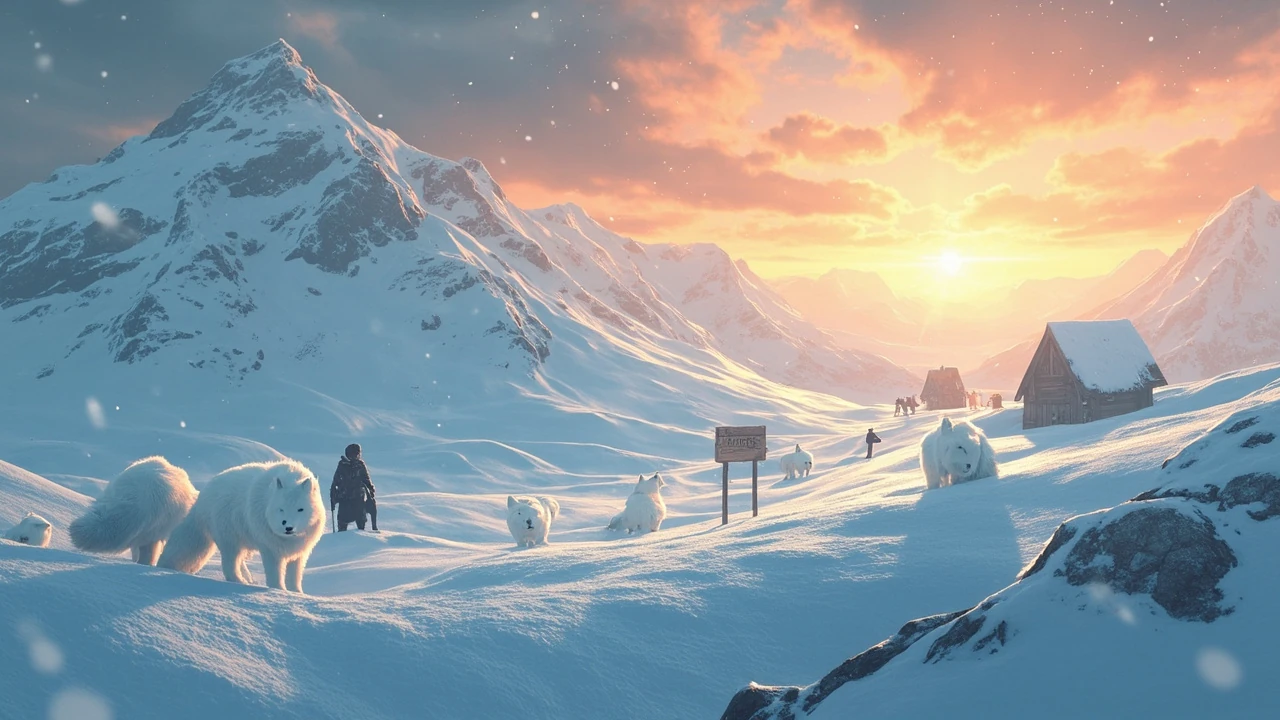
Snow white vulpix in the snow: a request worth studying from a production standpoint
Among the dozens of side activities in Pokémon Legends: Arceus, the Request known as Snow White Vulpix in the Snow stands out for how cleanly it demonstrates a side-content design pattern. It is short, it is highly visual, and it asks the player to actually traverse a corner of the Alabaster Icelands rather than reading a menu. The in-game premise is simple: a researcher named Keaka has lost five Alolan Vulpix around the Avalanche Slopes, and the player has to find them. The production premise behind that loop is more interesting, because it tells a developer a lot about how to disguise busywork as a guided tour, how to gate content behind a request board, and how a single low-cost asset variant can carry an entire mission.
For a GameDev blog, Snow White Vulpix in the Snow is the kind of side content that is worth dissecting. It illustrates level design, quest scripting, environmental art economy, and a few quality-of-life ideas that smaller teams can borrow. It is not a full-blown case study, but the request is small enough to be readable in a single sitting, which makes it perfect for breaking down how a small open-world team uses one creature, five spawn points, and a clear story to add value to a corner of the map that most players would otherwise ignore.
What the Snow White Vulpix in the Snow request actually is
Snow White Vulpix in the Snow is Request 83 in Pokémon Legends: Arceus. Mechanically, it is a five-step search quest with a single cutscene at the start and a small reward handover at the end. The play time for an experienced player is around ten minutes, mostly spent traveling and looking. The play time for a new player is longer, because the Avalanche Slopes area invites exploration even when the player only wants to finish the request.
The accepted structure is straightforward. The player picks the request up from the board in Professor Laventon’s office, then fast-travels to the Snowfields Camp in the Alabaster Icelands. There, Keaka explains that his five Vulpix, each named Keokeo, have run off, and asks the player to bring them back. The player then crosses into the Avalanche Slopes sub-region, locates each Vulpix by sight, and returns to the Snowfields Camp. Keaka thanks the player and rewards them with an Alolan Vulpix.
For a developer, the important thing about that structure is what is missing. There is no puzzle layer, no dialogue tree, no combat challenge, and no required capture mechanic. The “game” inside this request is purely spatial: where do I look, and can I reach that ledge. Everything else is framing. That framing is what makes the request feel like a discovery rather than a checklist.
The five Vulpix spawn points, mapped
Each Vulpix in the request is hand-placed. None of them roam, none of them respawn during the quest, and none of them are duplicated. That choice has a direct effect on how the player reads the world. A wandering Vulpix would encourage chasing, which would feel like a fetch quest. A static Vulpix encourages looking, which is closer to a search quest. The five placements below are the ones described on the public guide for the request, and they show how the designers used landmarks to anchor the player’s eye.
| Spawn | Sub-area | Landmark anchor | What the player actually sees |
|---|---|---|---|
| Vulpix 1 | Avalanche Slopes, east of the marker | Cone-shaped hill, Lickitung activity | A small fox on top of a low snow mound, framed by passing Lickitung |
| Vulpix 2 | South of Vulpix 1 | Large rock among leafless trees | A Vulpix tucked behind a rock so the tail is the first thing visible |
| Vulpix 3 | East side, flat ledge | Vivichoke plant marker | A Vulpix sitting on a flat outcrop next to a named plant |
| Vulpix 4 | Southern snowy hill | Rocky mountainside corner | A Vulpix placed against a hard silhouette, easy to read against snow |
| Vulpix 5 | Western overlook | Ambipom group | A Vulpix overlooking the slope, framed by a cluster of other creatures |
Notice how every Vulpix is paired with at least one other readable element. Lickitung, a rock, a plant, a mountain corner, and an Ambipom group all act as secondary anchors. If the developer had simply placed each Vulpix on a flat snow patch, the white creature on a white background would have been nearly invisible, which is the exact trap the request name warns about. The team solved the contrast problem not by changing the Vulpix color but by placing the creature next to something dark or detailed.
Why the request is called Snow White Vulpix in the Snow
The title is doing a small piece of design work. It tells the player three things before the request even starts. First, the target is white, so the player should not expect the standard orange Vulpix. Second, the target is camouflaged, because the name itself draws attention to the difficulty of seeing white on white. Third, the request is a discovery activity, not a combat one, because the framing is observational.
A developer reading the title can also extract a fourth message: this is a request about visibility constraints. The Alolan Vulpix in this game is the same silhouette and animation set as the standard Vulpix, but the surface material is a near-white gradient. The team essentially asked, “what happens to a familiar creature when its surface treatment is hostile to the environment?” The answer, in game form, is the request itself. It is a 10-minute interactive essay on contrast, wayfinding, and player trust in landmark memory.
Designing a request around a single creature variant
The asset side of Snow White Vulpix in the Snow is interesting because the team reused the existing Alolan Vulpix model and animation set. The creature does not get a new rig, a new scale, or new moves. It only gets a re-skin and a new placement pass. The actual production cost of the request is therefore small. Most of the work is in scripting, dialogue, and level scripting, not in creature art.
| Production element | What the team reused | What the team had to build new |
|---|---|---|
| Creature model | Alolan Vulpix rig and animations | Re-skinned snow-white material pass |
| Creature behavior | Standard ambient creature AI | None, creatures do not flee or react |
| World placement | Existing Avalanche Slopes terrain | Five hand-authored spawn anchors |
| Story | Request board template, NPC base class | Keaka dialogue, Request 83 entry, completion VO |
| Reward | Existing capture and add-to-party pipeline | One Alolan Vulpix handover to the player |
That mix is the heart of why this kind of request is a good template. A studio can ship a new piece of content that feels fresh because of its framing, while the technical cost stays inside the existing creature, dialogue, and request pipelines. There is no new combat encounter, no new ability, and no new system to balance. The new work is mostly editorial: copy, placement, and reward.
How quest scripting keeps the player oriented
From a scripting standpoint, the request is unusually honest about its design. It does not pretend to have a tracking mechanic. There is no compass waypoint that points at each Vulpix, and there is no glowing indicator above the spawn point. The player is expected to navigate visually, using the landmarks described in the public guide.
This is a deliberate decision and it is worth understanding. A waypoint system would trivialize the request. The whole point is to make the player cross the Avalanche Slopes at least once and notice that the area has texture: a cone hill, a rock cluster, a plant line, a mountainside corner, an overlook. A waypoint would push the player along a single line, and the area would feel small. By removing the waypoint, the team makes the request act as a guided tour that pretends to be a search.
For other developers, the lesson is that the absence of a feature is sometimes a feature. A tracker is a fast way to reduce perceived complexity, but it also reduces perceived exploration. The right choice depends on the kind of world the team is building. A dense open world benefits from waypoints, while a frontier-style map like Arceus benefits from letting the player get lost on purpose.
Environmental art that supports a contrast problem
The Avalanche Slopes sub-region is the second lesson of the request. The terrain is mostly snow, with a few rock outcrops and a sparse tree line near the base. From a pure color-theory standpoint, this is hostile to a white creature. A naive art pass would have hidden the Vulpix completely. Instead, the environmental art team seeded just enough dark, mid-tone, and warm details to give the Vulpix something to stand against.
- Tree trunks and bare branches near Vulpix 2 break the white field with vertical dark shapes.
- Rock formations near Vulpix 2 and Vulpix 4 give the player a strong silhouette to aim at.
- The Vivichoke plant near Vulpix 3 introduces a small color accent that the eye can lock onto.
- The Ambipom group near Vulpix 5 adds motion and warm fur to a cold frame.
- Lickitung activity near Vulpix 1 creates a moving reference point that pulls the eye up onto the cone hill.
None of those environmental elements were added specifically for this request, but their placement relative to the Vulpix spawns is not a coincidence. Level design for quests is usually a final pass that ties existing art to scripted content, and Snow White Vulpix in the Snow is a clean example of that pass being done well.
Player guidance without a HUD
One of the most cited design decisions in Pokémon Legends: Arceus is the limited use of HUD waypoints in side content. Snow White Vulpix in the Snow leans into that decision. The only navigational help the player gets is the dialogue from Keaka pointing them at the Avalanche Slopes and the gentle suggestion to “take a left from the main camp.” Everything else is a visual read.
For developers, this is a useful pattern because it forces the design team to be honest about two things at once. First, the landmarks have to be real, not decorative. If the team has placed a “large rock” in the world, the player has to be able to see it from at least two angles. Second, the spawn points have to be readable from those landmarks. A Vulpix hidden in a forest that the player can only see from one direction will frustrate people who approach from the other side. The request survives because both conditions are met: the landmarks are big enough to read across a slope, and the Vulpix are placed close enough to those landmarks to be obvious once the player gets there.
Time-to-reward, session pacing, and the “ten-minute quest” idea
Snow White Vulpix in the Snow is a textbook example of a short, completable quest that fits inside a single play session. From accept to reward, the request is designed to take less time than the player usually spends in the Alabaster Icelands. That is not a coincidence. The team wants the player to be able to pick the request up, finish it, and keep playing in the same region. The For additional context, reward, an Alolan Vulpix, reinforces that loop: the player gets a new creature to add to the party and can immediately use it in the same map.
| Step | Expected time | Player activity | Pacing effect |
|---|---|---|---|
| Pick up Request 83 | 1 minute | Reading the board, accepting the request | Low-effort commitment |
| Travel to Snowfields Camp | 1 to 2 minutes | Map screen, fast travel | Sets player in the right region |
| Speak to Keaka | 1 minute | Cutscene, dialogue | Establishes motivation |
| Search Avalanche Slopes | 5 to 10 minutes | Running, climbing, scanning with the camera | Core engagement loop |
| Return to Keaka | 1 to 2 minutes | Travel back, dialogue | Closes the loop with a reward |
The interesting production takeaway is that the request pacing is driven by travel, not by challenge. If a developer wants to replicate this feel without copying the content, the simplest starting point is a quest that costs 80% of its time to traversal and 20% to a simple scripted beat. The longer the traversal feels, the more value the player assigns to the reward, even if the reward itself is small.
What the reward does, and why it is a clean fit
Keaka gives the player a single Alolan Vulpix at the end of the request. From a systems standpoint, this is a one-off creature placed in the party. It does not require breeding, it does not require a special ball, and it does not need a level gate. The reward is therefore easy to deliver, easy to test, and easy to re-balance. From a player standpoint, it is meaningful because Alolan Vulpix is a regional variant that some players might not have encountered yet, and the version the player receives can be the first in their party.
For a GameDev audience, the lesson is to align reward complexity with quest complexity. Snow White Vulpix in the Snow is a low-complexity request, so the reward is a low-complexity gift. There is no shiny, no hidden ability, no held item, and no gender choice. That keeps QA surface area small and prevents the request from becoming a vector for exploits. A more complex reward would have required more complex scripting, more edge cases, and more regression testing on every patch.
How the request fits into the wider side-content design
Snow White Vulpix in the Snow is one of dozens of similar requests in the game, but it has a specific role inside the Alabaster Icelands. The Avalanche Slopes are a transition between the Snowfields Camp and the higher mountain biomes, so the area gets a lot of foot traffic. The request acts as a soft “welcome” quest for that sub-region. A player who runs through Avalanche Slopes once for the Vulpix is likely to come back later to gather resources, because the area has already been mapped in their head.
This is a small but important pattern in open-world design. Side content can be used to teach the player the geography of a region without forcing them to read a map screen. The cost is one request and a few spawn points. The benefit is that every player who finishes Snow White Vulpix in the Snow now knows the rough layout of Avalanche Slopes, including the cone hill, the rock cluster, the plant line, the mountain corner, and the overlook. That knowledge pays off in every later visit, even if the player never thinks about the request again.
Common stumbling points when a team tries to copy this design
It is tempting to look at Snow White Vulpix in the Snow and assume the same pattern will work in any open world. In practice, the pattern only works when several conditions are met. The list below summarizes the conditions where the request reads well, and the conditions where it tends to fall apart.
- The target creature or object has to be visually distinct from the background in at least one property, such as shape, motion, or texture, even when color is hostile.
- Each spawn point has to be paired with a secondary anchor the player can see from at least one approach direction.
- The player has to be able to read the area as explorable, which usually means an open camera and a forgiving climb system.
- The reward has to be self-contained, so the request does not depend on a long, gated quest chain for the player to feel satisfied.
- The story has to be a single beat, so the player does not lose the thread if they leave the request and come back later.
Requests that violate those conditions often feel like a checklist. The player is sent to “find the thing” with no clear read on where the thing is, why it is hidden, or what they will get for finding it. Snow White Vulpix in the Snow avoids that trap because every step has a clear answer: the creature is white, the area is snowy, the Vulpix are near recognizable landmarks, and the reward is a real creature in the player’s hand.
Reusable patterns for small studios and hobby teams
For small teams, the most useful part of the request is the asset economy. A studio with one creature, one animation set, and one biome can use the same pattern to ship multiple side quests without ballooning the art budget. The pattern is essentially: pick a creature variant, pick a region, place five hand-authored spawn points near recognizable landmarks, and write a short dialogue. The technical cost of each request is roughly the same, so the team can ship a batch of them in a single milestone.
For hobby teams and game-jam projects, the pattern is even more useful because it is mostly about reading the world. A small team can build a single snowy scene, place five small props inside it, and write a quest that asks the player to “find them all.” The props do not need to be animated, the quest does not need voice acting, and the reward can be a simple collectible or a small power-up. The structure still teaches the player how to read the scene, which is the whole point of Snow White Vulpix in the Snow as a design exercise.
What a level designer can extract from the request
Level designers reading this kind of content can extract a small set of concrete rules. The request is short enough to read as a worked example, and the spawn points are described in enough detail to map against actual terrain. The rules below are not universal, but they hold up well for a single-creature, single-biome side quest.
- Pair every spawn with at least one anchor of a different color value or scale, so the player’s eye has somewhere to land.
- Distribute spawns across the area, not along a single line, so the player has to actually traverse the space.
- Use named landmarks that already exist in the world, so the team does not have to author new art for the request.
- Keep the spawn behavior passive, so the quest reads as a search rather than a chase.
- Close the loop with a single, clear reward event at a fixed location.
Each of those rules is something the team behind Snow White Vulpix in the Snow appears to have followed. The five Vulpix are spread across the Avalanche Slopes, not stacked in a line, and each one is paired with a readable secondary element. The reward is delivered in a single conversation at the Snowfields Camp, and the spawns are static, so the player can take the time to look at the world.
Limitations of the analysis
It is worth being honest about what this article does and does not cover. The internal scripting of Snow White Vulpix in the Snow is not public, so the exact trigger volumes, quest states, and edge-case branches are not part of this write-up. The placement descriptions are based on the public walkthrough of the request and on the visible behavior in the game, not on developer commentary. A team that wants to copy the pattern should treat the spawn descriptions as a starting point for their own pass, not as a guaranteed-correct map.
It is also worth flagging that the request is one entry in a much larger request system. Other requests in the same game use different patterns, including combat requests, crafting requests, and rescue requests. Snow White Vulpix in the Snow is interesting precisely because it is a minimal example, but the wider request system is a separate topic that would need its own article to cover properly.
Practical takeaways for the next request you ship
The cleanest takeaway from Snow White Vulpix in the Snow is that a small, well-placed request can do as much work as a much larger side quest. If a team is trying to add value to an underused corner of a map, the cheapest way to do it is to pick one creature, write a short story, and place the creature near a few landmarks. The player gets a reward, the team gets a deliverable, and the world gets a reason to be revisited. The same logic applies to other one-creature, one-biome patterns, and it scales surprisingly well when the team commits to it across an entire map.
For readers who want to play the request themselves, the public walkthrough on IGN is a reliable starting point. The page covers the request pickup, the spawn points, the dialogue with Keaka, and the reward, all of which are useful for understanding how the request is paced and where the landmarks sit. The same page is also a useful reference for developers who want to compare a real walkthrough against their own quest design. If you are building a similar request, reading Snow White Vulpix in the Snow as a player first and as a designer second is probably the fastest way to internalize the pattern.
For an external sanity check, the public walkthrough for this specific Request 83 is on the Snow-White Vulpix in the Snow page, which describes the pickup, the five spawn anchors, the dialogue with Keaka, and the final Alolan Vulpix reward in the same order the in-game flow follows. For a wider cultural reference, the Pokémon Legends: Arceus article summarizes the request system, the regional variant mechanic, and the role of Alolan forms inside the Hisui region. Used together, the two sources give a developer enough context to sketch a similar request inside their own engine, even if the visuals and creature set are entirely different.
For a small studio, the right closing thought is to treat this request as a reminder that a side quest does not need to be long to be valuable. Snow White Vulpix in the Snow is short, it is built on existing assets, and it teaches the player how to read a corner of the map. That is enough. The same shape can be repeated across a game, and each repetition is a chance to make a forgotten corner of the world feel intentional. For a GameDev blog, that is the most useful lesson a single request can offer.
Frequently asked questions
What is Snow White Vulpix in the Snow?
Snow White Vulpix in the Snow is Request 83 in Pokémon Legends: Arceus. The player picks the request up from the request board in Professor Laventon’s office, travels to the Snowfields Camp in the Alabaster Icelands, and helps a researcher named Keaka find his five missing Alolan Vulpix around the Avalanche Slopes. When all five are returned, Keaka thanks the player and gives them a single Alolan Vulpix as a reward.
Where do I start the Snow White Vulpix in the Snow request?
The request is started from the request board in Professor Laventon’s office in Jubilife Village. After accepting it, the next step is to fast-travel to the Snowfields Camp in the Alabaster Icelands and speak with Keaka, who stands near the camp and explains what has happened to his Vulpix.
How many Alolan Vulpix are there in the request?
There are exactly five Alolan Vulpix to find during Snow White Vulpix in the Snow. They are all in the Avalanche Slopes sub-region, which is the southwestern corner of the Alabaster Icelands. Each Vulpix is hand-placed near a different landmark so the player can locate them by sight.
What are the five Vulpix spawn landmarks in Snow White Vulpix in the Snow?
The first Vulpix sits on a cone-shaped hill east of the Avalanche Slopes marker, the second is behind a large rock near a leafless tree cluster to the south, the third sits on a flat ledge near a Vivichoke plant, the fourth is against the rocky mountainside at the southeastern corner, and the fifth overlooks the slope near a group of Ambipom on the western side.
How long does the Snow White Vulpix in the Snow request take?
For an experienced player, the request takes around ten minutes from accept to reward, with most of that time spent traveling and scanning the slope. New players usually take longer because the Avalanche Slopes invites exploration, and the Alolan Vulpix are easier to miss in the snow than the standard orange variant.
What is the reward for finishing Snow White Vulpix in the Snow?
The reward is a single Alolan Vulpix, given by Keaka at the Snowfields Camp after the player reports back. The Vulpix is added to the player’s party directly, so no capture mechanic or special Poké Ball is required to claim it.
Why are the Vulpix hard to see in Snow White Vulpix in the Snow?
Alolan Vulpix is a regional variant with a near-white coat, and the Avalanche Slopes are dominated by snow. A white creature on a white field is hard to read at a distance, which is the core contrast problem the request is built around. The spawn points are paired with darker or more detailed anchors, such as rocks, plants, and other Pokémon, so the player has something to aim at even when the Vulpix itself blends in.
Can the Vulpix in this request run away or be knocked out?
No. The Vulpix in Snow White Vulpix in the Snow are static, scripted spawns. They do not roam, do not flee when the player approaches, and cannot be knocked out by other creatures. The interaction is purely visual, which is why the quest reads as a search rather than a chase or a battle.
Is Snow White Vulpix in the Snow a good example of side-quest design?
It is a useful example because it is small, it reuses existing assets, and it teaches the player how to read a corner of the map. It is not the only pattern the game uses, and other requests in Pokémon Legends: Arceus involve combat, crafting, and rescue mechanics. As a worked example of a one-creature, one-biome search quest, however, Snow White Vulpix in the Snow is one of the most readable in the game.
Do I need any special item or ability to finish the request?
No special item or ability is required. The player only needs the ability to traverse the Avalanche Slopes, which is unlocked through normal story progression in the Alabaster Icelands. There is no required mount, no required Poké Ball, and no required craft, so the request is open to any player who has reached the Snowfields Camp.


Leave a Reply